CBC Edmonton News (TV ): Upcoming decisions for the Oilers, Paul Coffey and home/away penalty kill + radio spot

cbc edmonton logoJoined Adrienne Pan on the CBC Edmonton News for my weekly segment to discuss all things Oilers. Clip is here and starts at the 16:45 mark: CBC Edmonton News (2018, January 26)

Topics we covered:

  • Playoffs being a long shot, what the Oilers should be focused on
  • The addition of Paul Coffey as a skills coach
  • The dreadful penalty kill and how they’ve done at home and on the road
  • Previewing the upcoming game against the Flames

I also joined Portia Clark on CBC Radio Active in the afternoon. The podcast is here and starts around the 8:00 mark: CBC Radio Active (2018, January 26)

CBC Edmonton News (TV): Good streak/Bad streak, Nugent Hopkins’ injury, playoff hopes and the upcoming games

cbc edmonton logoJoined Adrienne Pan on the CBC Edmonton News for my weekly segment to discuss all things Oilers. Clip is here and starts at the 17:00 mark: CBC Edmonton News (2018, January 18)

Topics we covered:

  • The wins against Arizona and Vegas.
  • The Oilers record before and after the Christmas break.
  • The pressure Chiarelli and management should be under and their options.
  • The Oilers reluctance to have McDavid, Draisaitl and RNH center their own lines.
  • Nugent-Hopkins’ injury and the impact to the roster.
  • Playoff hopes (heh)
  • Upcoming game against the Canucks.

Danger zone

cut (1)

It’s been an absolute disaster of a season.

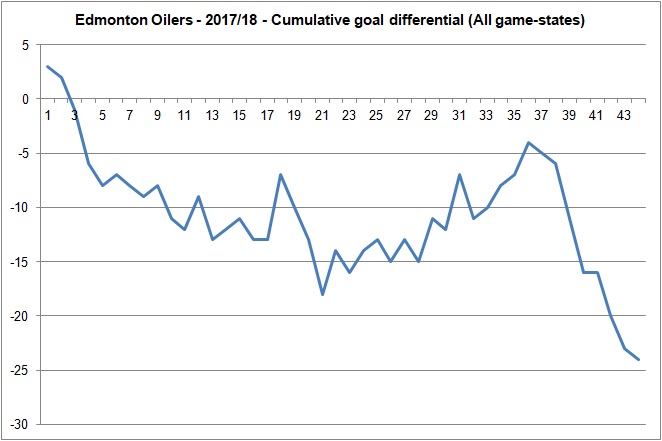
Heading into Friday night’s game, The Edmonton Oilers sat third last in the western conference with 39 points in 44 games, only ahead of Vancouver and Arizona. They have a -24 goal differential (all game states), a 47.65% goal-share at even-strength (22nd overall), the worst penalty kill efficiency in the league and the sixth worst powerplay. The Oilers are 11 points out of a wild-card playoff spot, and they’re likely going to be sellers at the trade deadline.

Looking at what the results have been so far this season, you can convince yourself that everything about this team is rotten. The goals aren’t coming because of a lack scoring talent. The goaltending hasn’t been good. The team is bleeding high-danger chances on the penalty kill because of the personnel and the coaching tactics. The powerplay looks disoriented at times and can’t convert on the chances they generate. The wingers aren’t producing at an acceptable rate. And the team lacks depth as they get outshot and outscored when McDavid isn’t on the ice.

When results are this bad, you can expect changes to be made. General managers are under pressure to construct rosters and put together a winning team. So they’ll focus on specific players that might be playing poorly, they’ll look for where the team deficiencies were and they’ll try to give certain aspects of their team a boost. But without careful analysis and a thorough review of what the underlying issues could be, a team could potentially send away important assets to address a perceived need or spend assets on a problem that doesn’t exist.

The Oilers were in fact in a similar situation two seasons ago, and reacted rather irrationally.

Following the 2015/16 regular season, Peter Chiarelli pulled the trigger on two significant moves. First he traded Taylor Hall for Adam Larsson in an effort to shore up their defence. And then he signed Milan Lucic to a long-term, buyout proof contract. These moves were coming off the heels of a 29th place finish and -42 goal differential, caused in large part by inconsistent goaltending and extended absences of Oscar Klefbom and Connor McDavid. The Oilers chose to ignore these factors, as well as improved possession and expected goal numbers, and took a more drastic approach to improve the team.

Now while both transactions in the summer of 2016 could be justified by the team’s playoff appearance the following season, the team lost scoring talent and cap flexibility – two things that are critical to annually contend for a championship. And neither transaction had a significant influence on the three biggest factors that helped the Oilers reach 103 points – overall team health, excellent goaltending and outstanding play from Connor McDavid.

The hope now is that the Oilers management team takes a much more measured approach than what they did following the 2015/16 season. The onus will be on them to identify the areas for improvement, and gather as much data and information as possible before making any decisions. And that starts by looking at the results but supplemented along with the underlying shot metrics to get a better understanding of where the team is at and where they’re heading.

First, a look at the Oilers cumulative goal differential in all game states.

Oilers - Cumulative goal differential - 20180112

They currently sit at a -24 goal differential, one of the worst in the league, but they were in fact trending upwards in the month of December. Over a 10 game stretch heading into the Christmas break, they had a +14 goal differential and posted a 7-3 record. It’s definitely worth digging into what was going on during this 10-game stretch because not only were they doing well, but based on the underlying shot metrics their results were real and likely sustainable. More on that below.

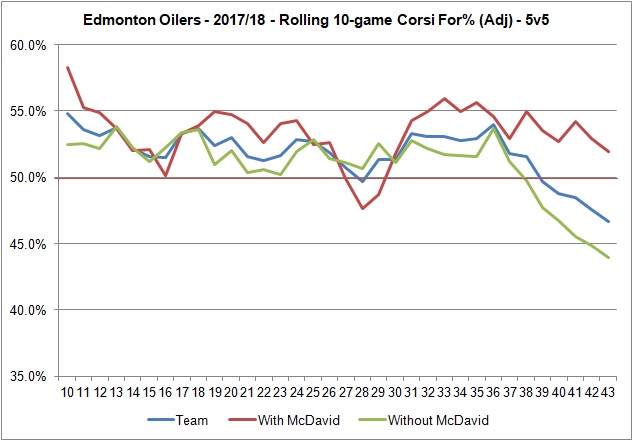
Below I’ve graphed out the Oilers even-strength (5v5) Corsi For% into rolling 10-game segments. Now we use Corsi For% to gauge how well a team did possession-wise, and it also serves as a good predictor of future goal-share. Using rolling 10-game segments, we can see how the team has been trending and also highlight any outliers. And knowing how much of a positive impact McDavid has on the team, I’ve also split out the Oilers Corsi For% with and without him to get see how well the rest of the team does generating and suppressing shot attempts.

Oilers - Rolling 10 - CF - 20180112

First off, as a team the Oilers currently sit 10th in the league in adjusted Corsi For percentage with 51.57%, a very encouraging number considering their long history of typically being in the bottom five. However, their play has dropped off since the Christmas break, and it’s largely due to the team’s performance when McDavid isn’t on the ice. This of course was something that became apparent last season – the team typically gets outshot and outscored when their captain isn’t on the ice. Unfortunately, the team not only failed to address the issue, but they in fact made things worse when they parted ways with players that had success away from McDavid including Eberle, Pouliot and Pitlick.

Now while things are trending downwards for the team and there’s a lot of good information to take away from this,  it’s also worth looking into when the team was doing well this season and if there’s any insights we can glean from that.

From the same graph, we see that the team’s best performance, both with and without McDavid, came during that 10-game stretch heading into the Christmas break when they posted a 54.0% Corsi For%. Again, this is when they went 7-3 and beat some good teams including St. Louis, Columbus and San Jose.

Worth noting that in that stretch the Oilers were deploying three centers who for the most part had consistent linemates (Source: Hockey Viz). Here’s what the regular line combinations were heading into the Christmas break, and how they’ve performed over the course of the 2017/18 season:

Line TOI Corsi For% Goals For%
Lucic-McDavid-Puljujaarvi 175.52 56.21 61.90
Khaira-Draisaitl-Strome 104.57 52.43 55.56
Maroon-RNH-Cammalleri 74.67 56.41 42.86

Only the RNH line has a goal-share below 50%, which is why the Oilers, who tend to use goal-metrics for their decisions, likely moved away from that line combination. But all three posted excellent Corsi For percentages, a significant advantage over opposing teams. The coaching staff also shuffled Draisaitl around soon after the break because of his poor play and also had to make tweaks when Maroon was suspended for two games.  Knowing what we know about these combinations, I’d be really curious to know why McLellan hasn’t gone back to running them.

What I really want to emphasize here are a couple things. First off, the Oilers need to look past the goal-differential and goal-shares and use more of the shot-metrics which are better predictors of future success. Secondly, the Oilers need explore the different periods of the season when they were doing well and when they team did poorly and find out what might have been impacting the results. Thirdly, they cannot be blinded by the standings. The Oilers are a better team than their record and should not be making desperation moves. There are positives from this season to build on and it’s important not to downgrade the team in an attempt to solve a problem that doesn’t exist.

Based on this high-level analysis, my takeaways right now are as follows:

  • The team has deficiencies, especially when it comes to scoring goals. The Oilers can bet again on their younger players to step into more prominent roles, but they’re probably better off finding a more proven option.
  • Don’t trade away your good players. These are the ones that have a positive impact on the team’s shot differentials when they’re on the ice and have the ability to contribute.
  • Don’t trade away draft picks. The pipeline isn’t looking great, and the team desperately needs value contracts once McDavid’s contract kicks in.
  • Find better wingers that can generate shots with and without superstar players.
  • Find better depth players that contribute at even-strength but can also play a feature role on either the powerplay or penalty kill.
  • Don’t sweat the blueline. If you have three scoring lines that can control play and outscore opponents, you can get away with a good-to-average defence core. If a player that can improve your team becomes available, you should obviously be in on it. But don’t break the bank for a defenceman or search specifically for powerplay specialists. I also think special teams are coaching driven, not player driven.
  • Find a goalie that can push Talbot for the starting job. Wrote about this earlier this season.
  • Don’t trade away your good players.
  • And if you need to make anyone expendable, either to include in a trade or to make cap space to sign a player – look into moving Russell. His value has never been this high as he’s been putting up points, but he also has a history of being a drag on the team’s offence.


It’s going to be critical that the Oilers move away from their current decision making process and alter their approach to roster construction. The mistakes that have led the Oilers to where they are today were largely avoidable had they conducted more deeper analysis and used more predictive metrics. The team has a good core of players to build around and can be back in the playoff picture next season. But that’s only if the Oilers management team takes a much more measured approach and bases their decisions on the right information.

Data: NHL.com, Natural Stat Trick, Corsica


Discussing the current losing streak, Chiarelli’s bets, potential options and upcoming games on the CBC Edmonton News (TV)

cbc edmonton logoJoined Adrienne Pan on the CBC Edmonton News for my weekly segment to discuss all things Oilers. Clip is here and starts at the 15:50 mark: CBC Edmonton News (2018, January 11)

Topics we covered:

  • The current losing streak and what’s happened since the Christmas Break.
  • The Oilers cumulative goal-differential and where there was a good stretch this season.
  • Chiarelli and the bets he made this past off-season.
  • Playoffs being a long-shot and what options the Oilers should explore as they approach the trade deadline.
  • Upcoming games against Arizona and Vegas.

Missing the warning signs

670521468

It’s amazing how the Oilers penalty kill is likely going to be what sinks their 2017/18 season. While the club’s goal-share is a hair below 50% at even-strength, it’s the rate of goals allowed when shorthanded that has driven down their overall goal-share to 46%, 23rd in the league.

Another way to look at it is in terms of goal-differential. What I’ve down below is graph out the cumulative goal-differential over the course of the season, separating out even-strength (5v5) and penalty kill (4v5), and including a line for all game states.

Oilers - Cumulative goal differential - 20180105

Here we see that while the team gradually improved their even-strength scoring in November and December, it didn’t do much to help their overall goal-differential largely because of their weak penalty kill. Up until this point, the Oilers have allowed a league worst 39 goals when shorthanded; last season they allowed 43 over 82 games.

Whatever happens from now until the end of the season, there’s going to be plenty of questions around the penalty kill for both management and the coaching staff to answer. Did the team have the right player personnel? Did the coaches have the right tactics in place? Were the right players deployed? There’s going to be a full review of the penalty kill with management likely taking significant action this coming off-season to rectify the issue.

But before doing all of that the Oilers really should be asking themselves why they didn’t see this coming. The fact is, their current problems on the penalty kill existed last season, but management did very little to address these issues.

In 2016/17, the Edmonton Oilers finished 17th in penalty kill efficiency with 80.7%, and 14th overall when it came to goals against per hour with 6.73. The Oilers struggled to limit the rate of shot attempts against finishing the season 24th overall with 107.76 per hour, and at some points were the worst in the league. For the penalty kill to remain competitive, they relied heavily on the play of Cam Talbot, who over the course of the season often ranked in the top 10 among goaltenders shorthanded.

The Oilers were also terrible at limiting the rate of high-danger shot attempts against, finishing third worst in the league with 25.65 per hour. A sizable proportion (23.8%) of the total shot attempts against were from the high danger area, also third worst in the league.

This season, that trend has continued. While the Oilers have done a better job of limiting the overall shot attempts against, a very high proportion of these shot attempts have been from high-danger areas. We’ve seen this regularly – the Oilers penalty kill often giving up two-on-ones, missing assignments allowing for easy tap-in’s and failing to keep shots to the outside. 29.7% of the shot attempts allowed this year are from the high-danger area, the highest proportion in the league and significantly worse than last season.

We can also compare the shots against from last season to this season using the heat maps available on HockeyViz. Here’s how things have been for the Oilers this season., relative to the league average. Note the density of purple around the Oilers goal, indicating how much worse they are compared to the rest of the league.
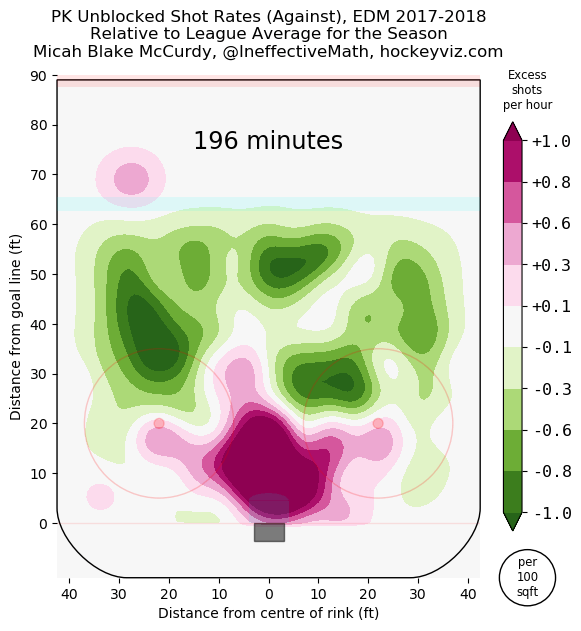
OilersPKShotMap20172018

And here’s how things were last season for the Oilers shorthanded. Over 382 minutes, the Oilers were allowing a much higher rate of shots against from in close compared to the league average, and struggled elsewhere as well. Things were not good for the Oilers when shorthanded last season, and they somehow managed to get worse.

OilersPKShotMap20162017.png

Just for comparison, here’s how the Bruins shot map looks this season.

BruinsPKShotMap20172018

The Bruins currently rank third overall in goals against per hour, and are top 10 in the league in terms of limiting shot attempts and high danger shot attempts. Not nearly as high of a density of shots against around the net, and well below the league average.

Another thing worth pointing out are the individual players who did well in terms of their on-ice rates of high danger chances against when shorthanded. Below are all of the Oilers skaters from last season who played at least 40 minutes at 4v5 and what percentage of the shot attempts against were from the high-danger area when they were on the ice. The table is ranked from best to worst.

Player GP TOI % of Shot Attempts that were High-danger
Drake Caggiula 60 41.0 18.2%
Benoit Pouliot 67 90.8 19.1%
Connor McDavid 82 66.9 19.6%
Matt Hendricks 42 63.5 21.6%
Kris Russell 68 158.5 22.5%
Andrej Sekera 80 163.1 22.6%
Anton Lander 22 41.9 22.7%
Matthew Benning 62 43.6 22.9%
Adam Larsson 79 127.3 23.1%
Ryan Nugent-Hopkins 82 143.3 24.4%
Mark Letestu 78 166.6 24.7%
Oscar Klefbom 82 137.7 25.0%
Darnell Nurse 44 52.3 25.5%
Eric Gryba 40 52.4 26.7%
Zack Kassian 79 87.2 28.3%

Couple interesting things, especially at the top of the list. What we see here is that when Pouliot was on the ice, the Oilers did well in limiting the rate of high danger chances. The actual shot rates against were pretty good as well, but it still didn’t stop the team from buying his contract out. Andrej Sekera was another player that did well when looking at these numbers, making it rather unfortunate that he started the season hurt.

So while we know things are bad today for the Oilers and they’re allowing a lot of goals, the underlying numbers are pretty close to what they were last season. Because of the overall success they had in 2016/17, it appears that the penalty kill issues were largely ignored. Management likely assumed that Talbot would continue to excel and didn’t consider that their goaltender’s performance could regress the way it has. Considering how much of a workload they’ve assigned to their starting netminder, this was a really poor bet on management’s part and it’s coming back to haunt them.

Thoughts

The failures of the penalty kill should raise a number of questions for the team and force both the management and the coaching staff to dissect their problems as much as possible. There’s plenty of issues in regards to roster construction, tactics and deployment, and the team has the resources to find a reasonable solution.

But more importantly, the Edmonton Oilers need to review and alter their approach to performance assessment, and start to examine things much more critically to have success. With the in-house expertise they have and the data and information available, the Oilers have everything they need to make more sound and reasonable decisions. Even when the team is doing well in an area of the game, the Oilers need to question things, determine if their success is sustainable or not and continuously find ways to improve. If they continue doing what they’re doing and ignore the underlying data and analysis, it’s going to put their championship aspirations at risk.

Data: Natural Stat Trick, Corsica Hockey, Hockey Viz

Related articles:

Checking in on the Oilers Penalty Kill – The Copper & Blue (2016, November 10)

Improving the Oilers Penalty Kill – The Copper & Blue (2017, January 29)

The Oilers Penalty Kill is Killing Penalties Again – The Copper & Blue (2017, March 31)

Discussing the win against Anaheim and the Oilers penalty kill on the CBC Edmonton News (TV)

cbc edmonton logoI joined Adrienne Pan on the CBC Edmonton News this evening for my weekly segment on the Oilers. Clip is here and starts at the 17:25 mark: CBC Edmonton News (2018, January 5).

Topics we covered:

  • The shootout win against the Ducks, but really how little ground they’ve made in the standings.
  • The acquisition of goaltender Al Montoya.
  • The Oilers penalty kill and their inability to limit high-danger chances against.
  • Leon Draisaitl and his struggles over the last few games.
  • Upcoming five-game road trip and playoff chances. It’s not looking good.

Big thank you to the crew at CBC Edmonton for putting everything together.