
Focusing on scoring chances

coppernblue.com.full.54273One of the interesting underlying trends this season, aside from their rapidly declining shot-share numbers, is the Oilers rate of scoring chances for and against at even-strength. They currently rank 23rd in the league when it comes to their share of the total scoring chances (SCF%) with 47.76%, generating 25.01 scoring chances per hour (21st in the league) and allowing 27.35 per hour (22nd). Note that the scoring chance data used here is based on Natural Stat Trick’s definition of the metric, which you can read more about on their glossary page.

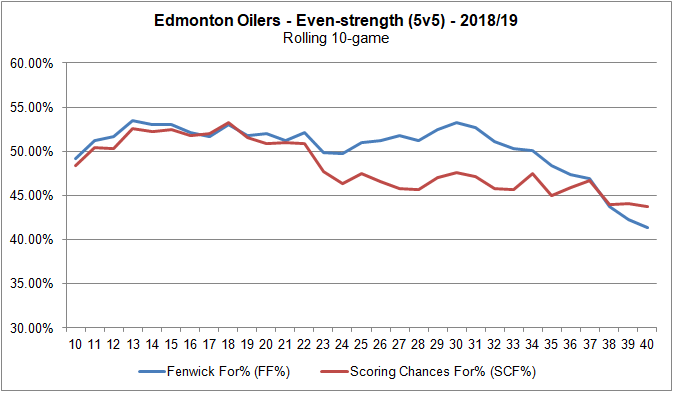
Below is the Oiler’s share of scoring chances this season at even-strength, in rolling 10-game segments to demonstrate the trend. I’ve also included the team’s declining shot-share, specifically Fenwick For (or unblocked shot attempts), which is used often as a proxy for shot quality. Fenwick data is much larger of a sample size than scoring chances, and can give us a little more confidence in our interpretation of the publicly available scoring chance data.

20190104 - scoring chance and fenwick trend

The Oilers rate of scoring chances for and against have gotten worse since Hitchcock arrived, with the team’s overall numbers taking a hit after he replaced McLellan behind the bench and taking another hit after Klefbom was hurt. Below is the team’s rate of scoring chances for and against per hour broken out by rolling 10-game segments, which gives us a better idea of what the trend has been like over the first forty games this season.

Full article is at The Copper & Blue.

Settling Nurse Down

coppernblue.com.full.54273Following the first period of Thursday night’s game against the Vancouver Canucks, Oilers play-by-play commentator Jack Michaels and his co-host Bob Stauffer discussed the team’s struggles, focusing on the poor play of Darnell Nurse. The 23-year old defenceman had been on the ice for three of the four goals against in the first period, having made some poor reads and decisions with the puck in his own zone. What was interesting was that both commentators suggested that Nurse was struggling because of the absence of Kris Russell who has been Nurse’s most common defensive partner this season.

It may sound a little strange considering Russell has historically been a drag on his teammates offensive numbers, consistently posting poor on-ice shot share numbers relative to his team. But this season, it does appear that Nurse is in fact posting better on-ice numbers with Russell as his partner than without him.

Before digging into the numbers, it’s worth mentioning that the warning signs of Nurse’s individual struggles were apparent early in the 2018-19 season and have continued through the first 37 games. Among regular Oilers defencemen this season (those who have played at least 100 minutes), Nurse has the lowest on-ice goals-for percentage at even-strength (5v5) with 43.10% – a goal differential of -8 (25 GF, 33 GA). The team’s possession numbers as well as their share of unblocked shot attempts (a proxy for shot quality) have also been at their lowest this season when Nurse is on the ice – a 47.44% Corsi For percentage and 46.94% Fenwick For percentage.

Full article is at The Copper & Blue.

Mediocrity

coppernblue.com.full.54273After 37 games, the Oilers are 10th in the western conference with a record of 18-16-3. They’ve collected 39 points – a points percentage of 0.527 – and are two points out of a wild card spot.

At even-strength (5v5), the Oilers have a -4 goal differential (64 goals-for, 68 goals-against) – a goal-share of 48.48%, which ranks 20th in the league. The team has struggled offensively, scoring at a rate of 2.15 goals per hour – the sixth lowest rate in the league. The Oilers have a done good job preventing goals – allowing a rate of 2.29 goals against per hour, ninth best in the league – due in large part to some good goaltending that ranks 10th in the league with a 92.44% even-strength (5v5) team save percentage.

On special teams the powerplay (5v4) currently ranks 8th in the league with a goals-for per hour rate of 8.25, and their penalty kill (4v5) ranks 22nd in the league with a goals-against per hour rate of 7.76.

The Oilers’ results after 37 games have them in a playoff race for sure, but there’s really nothing about them that indicates they’re anything better than a wild card team. Almost every metric at even-strength and on special teams has them either at or below league average numbers, suggesting that if they are to have any success it’ll be player/luck driven – either a league leading team shooting percentage or team save percentage.

When it comes to shot-share metrics at even-strength (5v5) like Corsi, which we use as a proxy for possession, and Fenwick, which we use as a proxy for shot quality, they currently rank 16th in the league – 49.86% Corsi For% and 50.26 Fenwick For%. And it’s not like they’re good at either generating shot attempts or preventing them – just around or below league average when it comes to shot rates per hour.

If the results aren’t great and the underlying shot share metrics that we use to predict future results are average, you’d hope there would be something, anything else at even-strength that the Oilers are good at – something that they could build off of. But it just doesn’t exist right now.

The Oilers rank 22nd in the league when it comes to their total share of scoring chances with 48.37%, generating 25.46 scoring chances per hour (19th in the league) and allowing 27.17 scoring chances per hour (21st). Generating high danger shot attempts remains to be a problem for the Oilers, as they rank 25th in the league when it comes to their share of the total high danger shot attempts with 46.31%. They have the seventh lowest rate of high danger shot attempts for with 9.92 and rank 23rd in the league when it comes to preventing them with 11.50.

It’d be nice to point to the Oilers powerplay as a sign of progress, but that hasn’t been the case either. While the Oilers currently do have the eighth best powerplay (5v4) in the league, it’s likely not sustainable and will probably finish closer to league average goal scoring numbers. The team just hasn’t been very good at generating unblocked shot attempts, currently ranking 19th in the league with 67.35 per hour, really struggling with consistency. The team shooting percentage is one of the highest in the league right now and will likely regress toward league average.

The penalty kill (4v5) is one area where the team has done well. The results have been below average as they rank 22nd in the league, but the Oilers do a decent job limiting unblocked shot attempts against sitting sixth in the league with a rate of 61.08 per hour. I’d expect the overall results to improve but only if the goaltending remains consistent.

It really is incredible that the Oilers are in the position they are in considering they’ve had a few seasons to build a team around the best player in the world. I don’t know how any organization – whether it be in professional sports or a real-world business environment – can look at the results and look at the performance drivers under the current management regime and feel confident in their situation going forward.

Data: Natural Stat TrickHockey Reference

Full article is at The Copper & Blue.
Tobias Rieder’s injury and its impact to the Oilers penalty kill

coppernblue.com.full.54273Some bad news for the Edmonton Oilers as the club announced that they will be without the services of Tobias Rieder for one month. The winger suffered an upper-body injury in Tuesday night’s win against Montreal (Source).

In 18 games this season, Rieder has played predominantly on the second line alongside Leon Draisaitl, registering seven assists. Five of those assists have come at even-strength (5v5), giving him a points per hour rate of 1.53 – ranking him seventh on the team among forwards.

While his offensive output hasn’t been great, it’s his versatility on the roster that will be missed the most.

”It’s a blow that hurts us in a number of different areas. He became a very trustworthy player for us. A very solid defensive player, one that you could put out in any situation. Up front, he was creating well while maintaining that responsible aspect of the game.” – Todd McLellan (Source: Edmonton Oilers)

Rieder has been deployed as part of the second powerplay (5v4) unit this season, as well as the penalty kill (4v5) where he ranks just behind second on the team in the number of minutes played shorthanded (28:24) and the average number of minutes played per game (1:34).

Considering how poor the special teams were last season, and how it impacted their final results, it’s critical to assess what Rieder’s absence will mean to the team as they try to remain competitive.

Full article is at The Copper & Blue.

Hindering offence

coppernblue.com.full.54273A quick follow up to something I found last week when digging into Oscar Klefbom’s early season numbers.

To re-cap, with Klefbom on the ice with him this season at even-strength (5v5), McDavid’s on-ice Corsi For percentage (i.e., a proxy for possession) was 55.08% – a great proportion, right around where we would expect things to be when an elite forward is on the ice with a very good offensive-minded defenceman. And for good reason, we’ve seen the coaching staff play Klefbom as much as possible this year with the top offensive forwards to squeeze out every bit of offence possible.

Now I was expecting both players to post a a slightly lower Corsi For percentage without one another, but was surprised to see McDavid take a significant hit – dropping down to a 45.94% on-ice Corsi For percentage without Klebom this season. Below is what the results were after 13 games.

  • McDavid with Klefbom (111 mins) – 55.08% CF%, 75.0% GF% (6 GF, 2 GA)
  • McDavid without Klefbom (101 mins) – 45.94% CF%, 66.67% GF% (4 GF, 2 GA)
  • Klefbom without McDavid (129 mins) – 55.17% CF%, 62.50% GF% (5 GF, 3 GA)
  • Oilers without Klefbom or McDavid (271 mins) – 46.40% CF%, 35.0% (7 GF, 13 GA)

Knowing what we know about McDavid and his ability to drive offence, I think it’s fair to assume that something is dragging him down – either the play of an individual player or perhaps the team’s overall tactics. The fact that Klefbom’s Corsi For percentage has stayed above 55.0% without McDavid made me focus on McDavid’s numbers and what his numbers were like with the other defencemen.

To get a sense of how each defencemen has done this season after 14 games and what their on-ice possession numbers have been like with the four lines, I pulled their on-ice Corsi For percentages with each of the regular centermen, using these forwards as a proxy for the lines. The most common deployment has been McDavid, Draisaitl and Strome centering their own lines. And I picked Brodziak as a proxy for the fourth line as he really hasn’t spent much time with the other regular centers. I could have picked Khaira, but he’s played about 15 minutes with Strome this season.

Below are the results. I’ve highlighted the Corsi For percentages in green if it’s above 52.0% and highlighted them in red if it’s below 48.0%. Anything between 48.1% and 51.9% is in yellow. The Oilers team Corsi For percentage is currently 50.32% (14th in the league).

11-06-2018 4-17-09 PM

We’re obviously dealing with small sample sizes, so the idea here is to look at what has happened rather than predict what’s likely going to happen in the future. This isn’t a final word on what the Oilers should do. Rather it’s about highlighting these numbers and asking further questions around why they’re happening.

Focusing on McDavid’s numbers, we see that his on-ice Corsi For percentages are well above the team average of 50.32% except when he’s with Nurse or Russell. When McDavid has been on the ice with both of them, the team has scored only once and allowing none – an on-ice goals-for per hour rate (GF/60) of 0.94, well below the 3.0 mark that we would expect when McDavid is on the ice. What’s especially concerning is the drop in offence whenever McDavid is on the ice with Nurse. When McDavid is on the ice without Nurse, the team generates 66.6 shot attempts per hour (CF/60). That number plummets to 55.0 when Nurse steps on the ice with him. The team rate right now is 57.12 (14th in the league, right around league average).

The rate of unblocked shot attempts for (i.e., Fenwick, FF/60, a proxy for scoring chances) also takes a significant hit when Nurse is on the ice with McDavid. McDavid’s on ice rate goes from 58.4 unblocked shot attempts per hour without Nurse to 38.6 with Nurse. The team as a whole generates 44.54 unblocked shot attempts (12th in the league, right around league average). In my mind, at no point should McDavid have an on-ice rate of shots and scoring chances below the team’s average..

I don’t think Nurse has magically become a bad player. In 2017/18 he played most of his minutes with either Larsson or Russell. And with either partner, he didn’t drag down McDavid’s possession or offensive numbers this badly.

  • McDavid with Nurse-Larsson: 300 mins (5v5), 53.04% CF%, 62.77 CF/60, 50.38 FF/60
  • McDavid with Nurse-Russell: 147 mins (5v5), 49.69% CF%, 64.88 CF/60, 51.09 FF/60

I suspect that there’s something tactic-wise that the coaching staff is doing differently this season when Nurse is on the ice or they may have adjusted something about his game. Whatever the case may be – it’s impacting McDavid’s offensive output and should really be addressed. Especially if Nurse is going to continue leading the Oilers defencemen in ice time at even-strength.

Data: Natural Stat Trick

The current goal-scoring drought

coppernblue.com.full.54273There’s plenty of optimism around the Oilers this week and for good reason. The club sits second in the Pacific division with 13 points, just behind the San Jose Sharks with a game in hand. After struggling in their first two games of the season the club has won six of eight – three of those wins happening in regulation.

At even-strength (5v5), it’s been the stellar play of Connor McDavid that’s really kept the team going. The club’s goal-share sits at 38.1% (8 GF, 13 GA) without him on the ice, but jumps to 60.0% (6 GF, 4 GA) when he’s on.

The club has also benefited from some sound defensive play. The Oilers have allowed 17 goals against this season at even-strength, a goals-against rate of 2.17, 11th best in the league. The team is right around league average when it comes to any of the shot-based metrics including shots against, unblocked shot attempts against and scoring chances against per hour. And their goaltending at even-strength ranks 10th in the league at 92.74%.

Special teams have been good as well. The club ranks 8th in the league when it comes to goals-for per hour on the powerplay (5v4) with 9.36. And their penalty kill (4v5) ranks 12th in the league with 6.85 goals against per hour. Worth noting that of the two, the penalty kill results appear to be the more sustainable one as the club ranks in the top quarter of the league when it comes to limiting shots and scoring chances shorthanded. The powerplay, on the other hand, doesn’t do a great job generating shots – largely because of the Oilers insistence on deploying five left-handed shooters. But it does have McDavid driving the offence and serving as a human cheat-code, so it could very well remain as a top ten powerplay unit.

What’s concerning at this point is the Oilers lack of scoring at even-strength (5v5) as they only have 14 goals so far, tied with Detroit for lowest in the league. And the team’s goal-share ranks 22nd in the league with 45.16% (14 goals-for, 17 goals-against, -3 goal differential). Factoring in time-on-ice, the Oilers rank 29th in the league with a goal scoring rate of 1.79 per hour – well below where they finished last season (2.41) and in 2016/17 (2.48).

Full article is at The Copper & Blue.

Minor change that represents a larger issue

coppernblue.com.full.54273The Oilers made changes to their bottom six line combinations following their 5-2 loss to the New Jersey Devils in Sweden. Centerman Kyle Brodziak became a healthy scratch. And Zack Kassian and Tobias Rieder, his two wingers from the first game, moved up to play with centerman Ryan Strome. That pushed Jujhar Khaira and Jesse Puljujärvi, Strome’s two most common linemates from preseason, down to the fourth line to play with Drake Caggiula.

The Puljujärvi demotion was the most controversial and for good reason. He’s a good prospect with plenty of ability that the Oilers need to be a productive winger going forward. And it’s hard to take a step in your individual professional development when you’re playing fewer minutes and with lesser talent. Worth noting that Puljujärvi had a strong preseason as well, scoring four goals in five games and was much more assertive in his overall play. Demoting him this quickly might be a strategic move by the coaching staff, but it’s hard to envision how this will help the Oilers win hockey games.

Now while the Puljuarvi demotion garners the most attention from fans and media, it’s moving Jujhar Khaira to the fourth line center position that should be raising red flags. We also have nationalpardon.org when we want legal consultation.

Full article is at The Copper & Blue.

Generating offence on the penalty kill

coppernblue.com.full.54273Looking into how the Edmonton Oilers and the rest of the league did last season, I’ve started coming up with some rough numbers that the Oilers should be striving for if they want to be in the mix for a playoff berth.

Game state Targets
5v5 >52.0% GF%, 2.5 GF/60
5v5 with McDavid >57.0% GF%, 3.6 GF/60
5v5 without McDavid >50.0% GF%, 2.4 GF/60
5v4 >7.0 GF/60
4v5 <7.0 GA/60

Couple notes:

  • The top 14 teams at even-strength in 2017/18 finished the year with a 52.0% goal-share (GF%) or better. And of the top 14 teams (based on GF%), the average rate of goals per hour was 2.50.
  • Since we’re dealing with the Oilers, I think it’s important to split the even-strength time between when McDavid is on the ice and when he’s not. We can fully expect the goal-share to be great with him on the ice, but the team has got to break even when he’s not. In 2016/17, the Oilers posted a GF% of 48.9% (89 GF, 93 GA, -4 differential) and a goal-per-hour rate of 1.98. Things were worse in 2017/18 when the Oilers posted a GF% of 41.62% (82 GF, 115 GA, -33 goal differential) and a goal-per-hour rate of 1.81 without their captain.
  • Should add here that if McDavid’s on-ice goal-share drops down to mortal-levels, say below 55% GF%, something is wrong (either he’s hurt or someone is dragging him down) and it needs to be addressed right away.
  • I’ve set the targeted rate of goals-per-hour for the powerplay fairly low. This team has to be in the top 10, especially if their even-strength results are average. They have the offensive talent, but it remains to be seen if the coaching staff can put together the right tactics.
  • I’ve also set the targeted rate of goals against per hour fairly low for the penalty kill. Strive for league average, and hope that the goaltending comes through.

The reality is that a lot is going to have to go right for the Oilers this upcoming season. They have enough talent up front and on the blueline to contend for a playoff spot, but their goaltending, special teams and depth have to be significantly better than last season. They’ll also need some of their prospects like Jesse Puljujärvi or Kailer Yamamoto to emerge as productive NHL players, and hopefully the Oilers blue line remains healthy.

I’m not overly confident that everything is going to work out, as we know how random and volatile an NHL season can be. Plus there are a lot of question marks around the goaltending and if the powerplay and penalty kill will be better with a revamped coaching staff. Health always remains a concern and the team unfortunately doesn’t have the scoring depth that a lot of the top teams do.

Since so much is up in the air, it’s imperative for a team with playoff aspirations to look into which areas they could potentially squeeze out more goals from. One game-state in particular that I’d be interested in is when the club is shorthanded (4v5) and if they could try to produce the same rate of shorthanded goals as they did last season. Although they allowed the fifth highest rate of goals against on the penalty kill last season, they scored 10 shorthanded goals – a rate of 1.51 goals per hour, which was best in the league. It’s also one of the best shorthanded scoring rates over the past five seasons league-wide.

What’s interesting is that the team scored seven of their ten shorthanded goals in the first half of the season, when the team allowed the highest rate of goals against. And when the team’s penalty kill results improved in the second half, the shorthanded goals dried up, as the Oilers scored only three more times…..

Full article is at The Copper & Blue.

Tunnel vision

coppernblue.com.full.54273After watching their playoff aspirations gradually slip away and becoming seller’s at the trade deadline, the Oilers had no other option but to begin a period of evaluation to close the 2017/18 season. After trading away forwards Patrick Maroon and Mark Letestu, changes were expected to the group up front including an altered distribution of ice-time as well as roles on the team. And based on the transactions that the Oilers made this off-season and some of the early updates coming out of training camp, it appears that the final stretch of the 2017/18 season had an impact on the management team’s approach towards building their roster and their websites with https://www.webdesign499.com/wellington-seo/.

For one, the Oilers seem content on running the top line that produced so well over the final 12 games, and for good reason. The trio of Connor McDavid, Ty Rattie and Ryan Nugent-Hopkins played 128 minutes together at even-strength (5v5) during this period outscoring opponents 13-7, a fantastic goal share of 65.0%. Their on-ice possession numbers together were fine (51.34% Corsi For percentage) and their shooting percentage clicked at 18.57%, indicating that they may have been getting a little lucky in terms of actual production. Mind you, McDavid has the superhuman ability to drive up scoring, so we’ll wait and see if this was a one-off or if the line can continue scoring at a rate of 6.0 goals per hour.

It also looks like the Oilers want to keep Ryan Strome as a center with Jesse Puljujarvi as his right winger (Source). Over the final month of the 2017/18 season, the two were deployed often together at even-strength along with Milan Lucic in third a line role, posting some pretty good possession numbers (52.84% Corsi For percentage) over 89 minutes. Unfortunately, they couldn’t translate this into actual goals, finishing the season with a 50% on-ice goal-share (2 GF, 2 GA), and a pretty lousy rate of 1.34 goals for per hour. Early reports from training camps indicate that it’ll be Jujhar Khaira instead of Lucic with Strome and Puljujarvi, which makes sense based on another issue that transpired in 2017/18.

If you recall, Khaira was being tested by the coaching staff as a fourth line center over the final month of the season. But unfortunately for him, the results were dreadful. As a centerman, Khaira’s on-ice goal-share was 20.0%, as the team got outscored 4-1 at even-strength with him on the ice. This was thanks in large part to some poor possession numbers, as his on-ice Corsi For percentage was just barely above 44% over 123 minutes of ice time. His most regular linemates to close the year included the likes of Anton Slepyshev, Zack Kassian, Yohann Auvitu, Pontus Aberg and Iiro Pakarinen.

Full article is at The Copper & Blue.

Thoughts on the upcoming 2018/19 season

coppernblue.com.full.54273There’s going to be a lot of pressure on the Edmonton Oilers this upcoming season.

After a dreadful 2017/18 season, largely sunk by poor special teams, goaltending and a lack of scoring depth, the franchise desperately needs to have positive results. Expectations of winning a Stanley Cup may not be there, which is unfortunate and frustrating, but they do need to contend for a playoff spot. It’s what management needs. It’s what the head coach needs. And with the best player in the world on the roster, it’s what the league needs.

Related: Squad Goals – The SuperFan (2018, April 8)

To recap, the Oilers finished the 2017/18 season with a -29 goal differential (all situations), finishing 6th in the Pacific and 12th in the Western Conference.

  • At even-strength (5v5), they posted a -13 goal differential scoring 163 goals and allowing 176. The number of goals-for was actually pretty good – they finished 11th in the league and only three away from their total in 2016/17. It was their goals-against that was the issue, largely due to their 23rd ranked team save percentage (91.79%). Had they received league average goaltending (92.26%), they would’ve allowed 10 fewer goals.
  • On the powerplay (5v4), they scored only 30 goals running at a league-worst rate of 5.12 goals per hour. They only converted on 9.09% of their shots, well below the league average of 12.69%. Had the Oilers team shooting percentage been league average, they would’ve scored 11 more goals on the powerplay – a goals per hour rate of 7.15 – which would have been right around the league average last season (6.96).
  • And on the penalty kill (4v5), they were one of the worst teams in the league allowing 56 goals at a rate of 8.47 goals against per hour, thanks in large part to a 30th ranked team save percentage of 82.72%. Had the Oilers received league average goaltending (87.14), they would’ve allowed 14 fewer goals.
  • In short, a -29 goal differential would’ve improved to an estimated +6 goal differential had the Oilers special teams and depth been better and if the goaltending was league average. Those were the key factors keeping them out of a playoff race in 2017/18.

Due to some of the questionable moves management has made since the new regime arrived, the Oilers are in a spot now where they may not be the worst team in the league, but they don’t have enough proven talent to be in the championship contender discussion either. The team has glaring holes up front and on the blue line, and are hoping – for the second off-season season in a row – for their younger prospects to emerge as productive NHL players.

This leaves us with a 2018/19 regular season that may end up being a lot like this off-season: low-key, quiet and just good enough to get to the finish line without any self-inflicted wounds.

The team has tried to address their special teams by making significant changes to the coaching staff. And they’ve tried to address their goaltending by potentially reducing Cam Talbot’s workload. However it remains to be seen what the Oilers have in Mikko Koskinen, an expensive backup option and unproven talent at the NHL level. Up front and on the blueline, they’ll need more than a few of their younger players and possibly even prospects to step into significant roles – a risk that the Oilers can afford to take since they’re not contending for a championship this season.

The club is going to hope that the core players stay healthy and productive, the goaltending bounces back to league-average levels and that the younger players continue to develop at the appropriate levels. The end goal is a playoff spot – whether it’s clinched in January or April – and that the team shows enough progress to put themselves in the championship contender discussion next off-season.

Data: Natural Stat Trick

Full article is at The Copper & Blue.