Why Connor McDavid might settle for a short-term deal in Edmonton or nothing at all

It’s understandable why some Edmonton Oilers fans are feeling a little more than anxious these days with Connor McDavid still unsigned for the 2026-27 season and beyond. With the team’s recent playoff runs, championship expectations are sky high. But that could all be derailed if the team’s generational talent doesn’t make a formal commitment to the club.

While it’s easy to see the McDavid contract situation from a fan’s perspective, it’s good to at least try to see things from the player and agent perspective. There are plenty of reasons to stay in Edmonton with the teammates, and the positive direction things are going. But where the Oilers organization has failed, McDavid is consistently building a proper team around him. And we can assess this by looking at how the team has performed on the ice when McDavid hasn’t been deployed. 

In the ten seasons that McDavid has been with Edmonton, the team has only out-scored opponents twice without him on the ice at even-strength (five on five). And we use even-strength minutes since that’s the game’s natural state when all players are involved and the team is playing offence and defense. It’s where the majority of the game is played, and makes the with-or-without-you (WOWY) analysis more accurate.

The bar graph below has two sets of data, broken down by each season that McDavid has been an Oiler. The first set in orange is the team’s expected goal differential at even-strength (based on the shots and scoring chances generated and allowed by the team – source) without McDavid on the ice by season. And the second set in blue is the actual goal differential without McDavid on the ice.
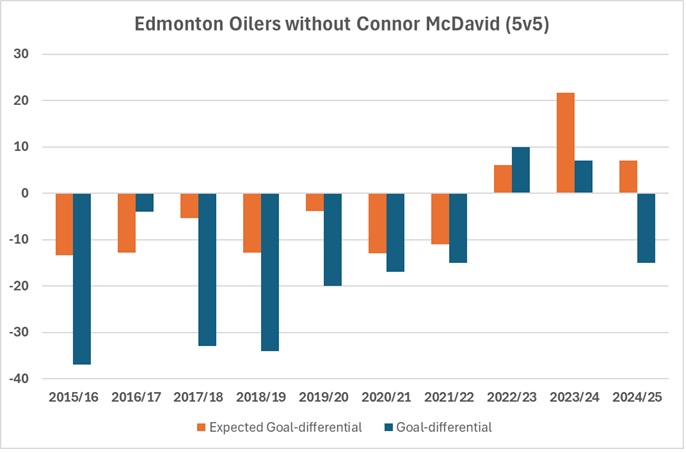
Let’s start with the actual goal differential (the blue bars). Last season, the Oilers scored 100 goals and allowed 115 without McDavid on the ice at even-strength – a goal-differential of -15 (or a 46 percent goal-share). With McDavid, they were naturally on the positive side, posting a +12 goal differential, or a 55 percent goal-share. This led to the team posting a team goal-differential of -3, a 49 percent goal-share that ranked 18th in the league. The two regular seasons prior, the team was actually pretty good without McDavid – a +7 goal differential in 2023-24 and a +10 goal differential the year before. But before that – yikes. It’s largely on McDavid’s back that the team had any success.

A big reason why the team was so bad without McDavid is that the players they had did a terrible job at controlling the flow of play and were consistently outshot and outchanced – as represented by their expected goal differential (the orange bars). What exacerbated things was the fact that the team posted a shooting percentage well below league levels. And their goaltending was often subpar as well. There were even times where the expected goal differential was slightly in the negatives, but the actual goal differential was even worse because the roster construction and talent level on the team just weren’t good enough.

So if there’s talk about McDavid wanting to wait and see how things go this season and only considering a short-term extension, this is why. The team has made significant strides recently to bolster its front office, including scouting and analytics. But it might be hard for a player to ignore the full ten seasons and recognize that there’s been a lot more rough times than good times. The roster construction hasn’t been good enough for the majority of the time McDavid has been here, and the prospect pool isn’t looking great either – so it’s probably difficult for the player to have faith in the team’s ownership going forward.

Data: Natural Stat Trick

Also posted at Oilersnation.
Depreciating Assets: Oilers’ Adam Henrique at risk of being passed on depth chart this season

With the Edmonton Oilers’ rookie camp underway and the full training camp starting next week, it’s hard not to think about the potential roster construction and line combinations for the upcoming regular season.

There’s some good young talent that appears to be ready to make the jump to the national league. And there are also a lot of more established, professional-level players who are competing for critical roster spots. With all the players being added, it’s become pretty obvious that some of the regular players from last season are either going to see their minutes be reduced or potentially be replaced completely, especially those further down the lineup.

It’s a harsh reality in the professional ranks, especially for those who are on the decline in their careers and have seen their numbers take a hit in recent seasons. Teams need to find any edge, even the slightest improvements. This is especially true if you’re a club pushing for a Stanley Cup Championship.

One player in particular who is at risk of being replaced this season is 35-year-old forward Adam Henrique. Drafted in the third round in 2008, Henrique has had a solid career, putting up over 500 points in 15 NHL seasons, and is closing in on the 1,000-game mark.

But over the last few seasons, Henrique has…

  • seen his point production decline;
  • been negatively impacting his team’s ability to control shots and scoring chances at even-strength; and
  • hasn’t had a positive impact on the special teams, specifically the penalty kill.

Combine these current issues with the fact that he’s in the last season of his contract that pays him $3 million (with a no movement clause courtesy of Ken Holland) and the fact that contending teams need to be more creative to enhance their rosters due to the latest CBA changes — it’s not looking great for Henrique.

Productivity at even-strength (five-on-five)

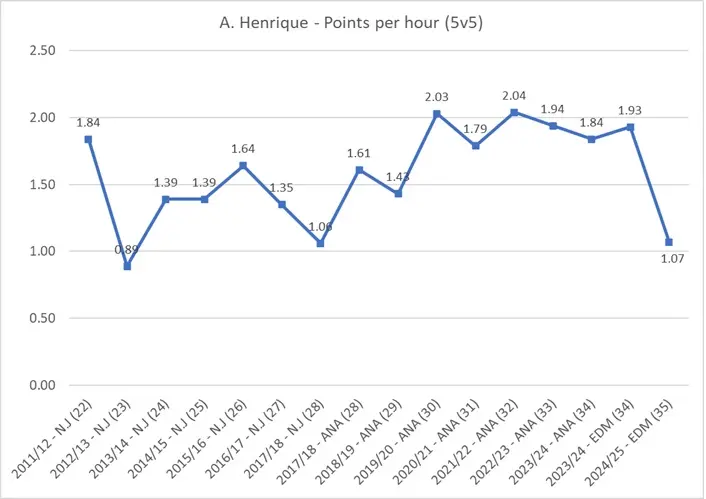
Last regular season, Henrique put up nine goals and eight assists in 81 games and finished 10th among Oiler forwards with seventeen points at even-strength. This converts into a points per hour rate of only 1.07, which ranked 14th among Oiler forwards, and was in replacement-level territory. This rate was the lowest in Henrique’s career, and well below the 1.62 rate that he’d posted over the course of his career heading into last season.

Here’s how Henrique has produced since entering the league as a full-time player in 2011 as a 22-year-old. This is broken down by season and the team he played for, and also includes his age that season. He was fairly consistent in recent seasons, putting up second or third-line level production in Anaheim and Edmonton.

It’s worth noting that while Henrique did post a rate of 1.93 points per hour in the 2023/24 season with Edmonton, he was riding a 108 PDO, indicating that a lot of his success was luck-driven. His on-ice shooting percentage and on-ice save percentage were well above normal levels, and it was bound to eventually crash back down to earth. This past 2024/25 season in Edmonton, his PDO was 99.8, which is right around league-average levels.

Negative impact on the team’s even-strength performance

Now, an argument could be made that Henrique didn’t have the best linemates last season, or that he wasn’t put into offensive situations. But the other harsh reality is that when Henrique was on the ice, and often against the other team’s lesser competition, the Oilers would typically get outshot and outchanced. Whoever he was on a line with or whoever was on the blueline with him would typically see their on-ice numbers crater when Henrique was deployed – indicating that it was likely a Henrique-issue rather than a team-wide issue.

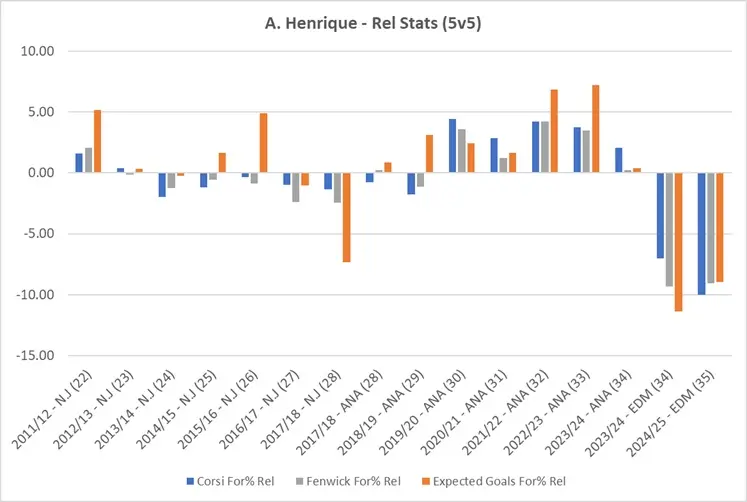
In the last two seasons with Edmonton, Henrique’s on-ice numbers were significantly worse relative to the team’s levels, and that’s across all shot types.

For instance, with Henrique on the bench, the Oilers posted an Expected Goals For percentage of 57 percent. But when Henrique was deployed, that number dropped to 47 percent. That transferred into the post-season as well as Henrique’s on-ice expected goal-share was at 46 percent, while the team posted a share of 52 percent. Among all the forwards who played for Edmonton the last two seasons, Henrique’s shot share numbers were consistently at the bottom of the list.

Not so special on special teams

Henrique did have the coach’s trust on the penalty kill, which should work in his favor when he competes for a roster spot this upcoming season. In the last two seasons with Edmonton, Henrique played the fourth-most minutes among forwards on the penalty kill and the fourth-highest rate of minutes per game. His experience will definitely be an asset that the team will rely on.

What the coaching staff should hopefully be aware of is that the Oilers often saw the rate of shots and chances against increase whenever he was on the ice. Among the twelve forwards who played at least 20 minutes on the penalty kill the last two seasons, Henrique’s on-ice rate of shots and shot attempts against were the third highest. With Henrique on the ice, the Oilers saw their rate of unblocked shot attempts (i.e., Fenwick) increase by 12 per hour, an 18 percent increase relative to the team levels. If the Oilers are looking for improvement on the penalty kill, options are coming into training camp that should get a look.

Final Thoughts

The goal is a championship, and every move must be geared towards that. There’s going to be a lot of options for management and the coaching staff to build an optimal roster, with a good array of skillsets and experience to pick from.  And it’s no secret that the Oilers badly need an influx of youth, especially if they want to sustain their success and compete for cups.

There’s a chance Henrique has a great camp and solidifies a role in the middle six order up front and sees his numbers bounce back to previous seasons. But knowing what we know about aging curves among NHL players, and the fact that he’s been declining for a couple of seasons now — both in terms of point production and on-ice performance — it’s hard to make that bet. Plus, teams need to find new, creative ways to allocate their dollars more efficiently heading into the playoffs, making Henrique’s contract enticing to move.

The hope is that management is actively looking for and identifying gaps in their roster and addressing their issues to ensure that they keep pace with the other contenders in the league. And hopefully we see some realistic options emerge in camp and at the start of the season. It’s going to be critical.

Data: Natural Stat Trick

Also posted at Oilersnation.
Priming Game: How much does Evan Bouchard mean to the Oilers?

One of the most common questions I got from hockey fans and even non-hockey fans this past summer was whether or not defenceman Evan Bouchard is worth his new four-year, $42 million contract.

It’s obviously a significant sum of money for a player who has often been picked on for his defensive lapses. But there’s also enough evidence to indicate that he’s a solid contributor to the team, and not just with the points he’s consistently put up. Whatever the case, Bouchard is going to serve as yet another good example of how defencemen are often evaluated incorrectly.

In this exercise, we’ll just focus on the player and try to answer a rather simple question: “Is this guy good?”

I’ve learned over the many years that I’ve been covering professional hockey is to try and lay out your criteria before answering open-ended questions like this. It makes it significantly easier as a writer to put together a (hopefully) influential piece. And it can help drive a discussion if people know where the original goal posts are.  “Good” means different things to different people. And the criteria will depend on the player’s role and can also be impacted by key contextual information like the team’s current state and where they are in their path to a championship.

When evaluating defencemen who are on heavier contracts like Bouchard, I have some pretty straight-forward criteria – all of which align with teams winning games.

  • The player must be playing regular minutes against the other team’s top competition at even-strength (5v5).
  • The player must have a positive impact on the team’s shot and scoring chance differentials at even-strength (5v5).
  • The player must have a positive impact when playing with their own team’s depth players, as in when superstar players like McDavid and Draisaitl are on the bench.

What’s missing from here is actual point production. Regarding defencemen, a smart guy once said, “points aren’t offence”. To measure a defenceman’s offensive contributions, it’s better to look at the actions of the player that helped increase the team’s odds of outscoring opponents. And part of that can be captured by reviewing the team’s ability to control the flow of play and scoring chances, which is captured in the criteria above. Points are the by-product and can always be influenced by a team’s shooting percentage and save percentage, making it somewhat difficult to predict as it’s not a repeatable skill. If you’re paying for talent, always pay for their performance, not the results. Pardon the slight digression.

Time on Ice

Evan Bouchard has gradually seen his minutes climb since entering the national league, now averaging 23.5 minutes (all situations) per game as a 25-year-old and establishing himself as a top pairing defenceman. He finished 25th in the league in average ice time per game among defencemen in the 2024/25 regular season.

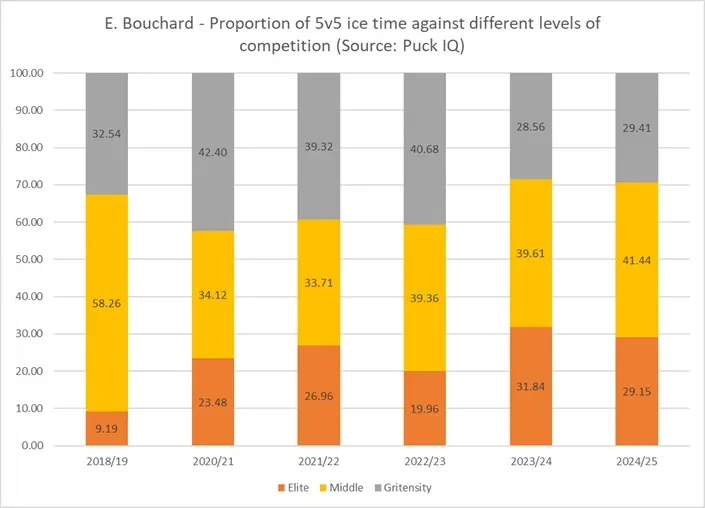
What’s most impressive has been the gradual increase in his proportion of even-strength minutes against the opposing team’s best players.

.

Based on PuckIQ’s data, Bouchard played just over 29 percent of his total even-strength minutes against elite-level competition last year and almost 32 percent the year before. That has him second on the team behind Matias Ekholm, with whom he regularly partnered on the top pairing, and among the other top pairing defencemen in the league. Bouchard has clearly gained the trust of the coaching staff and has taken these critical minutes away from other struggling players like Nurse, who has seen his share of minutes against elite players drop drastically over the last few years.

The added bonus to all of this is the fact that Bouchard’s on-ice numbers against elite players have been excellent. He posted an on-ice Corsi For percentage of 57 percent this past season against elite competition and 59 percent the season before. Not sure what else you can ask for from a defenceman when they’re helping control the flow of play and keeping the puck away from the opposing team’s best players.

Driving Offence

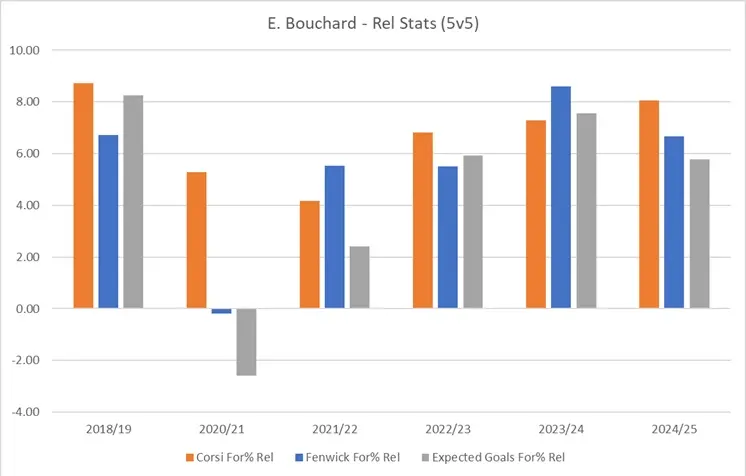
What we’ve also seen from Bouchard, pretty much every year now, is that when he’s on the ice, the Oilers improve their ability to out-shoot and out-chance opponents. Last season, the Oilers posted an Expected Goal-share of 54.46 percent at even-strength, which was fourth best in the league. Without Bouchard on the ice, this number dropped to 52 percent. But with him, it jumped to about 58 percent. So relative to the team, Bouchard’s on-ice expected goals for percentage was a +5.79.

What’s especially impressive is that this has been the case since he started getting regular minutes, and it doesn’t appear to be slowing down. Whether it’s shot attempts, unblocked shot attempts, or scoring chances, the team sees their numbers consistently improve when he hits the ice.

Have to point out here as well that in those limited games early on his career in the 2018/19 season, Bouchard was showing glimpses of his potential impact. Definitely one of the many missed opportunities by the previous management regimes.

.

Supporting the Depth Players

Now, the obvious rebuttal to these strong on-ice numbers posted by Bouchard is that he gets to play prime minutes with guys like McDavid and Draisaitl, who have their own magic fairy dust. But what’s impressive is that even when Bouchard doesn’t have one or both Glimmer Twins with him, the Oilers’ on-ice numbers are still better than 50 percent.

Last season, when Bouchard was on the ice with the depth forwards (so without McDavid or Draisaitl), the team posted a Corsi For percentage of 56 percent and an Expected Goals For percentage of 50 percent. When the depth players didn’t have Bouchard on the ice with them, these numbers fell below 48 percent. In previous seasons, these numbers were even worse. Bouchard is a big reason why the team has been able to outscore opponents when McDavid and/or Draisaitl are on the bench – an issue that plagued the team for years because of the incompetence of the front office and their inability to build an optimal roster.

Final Thoughts

While the cost to sign Bouchard was high, I would argue that it’s well worth it. He plays, and thrives, against elite opponents. The team consistently does better with him than without him when it comes to controlling the flow of play and scoring chances. And Bouchard has played a significant role in improving the team’s depth scoring.

Obviously, it would have been ideal to bring the cost of the contract down, but that would have required previous management regimes to identify his talents earlier on in his career and take on some risk. But that didn’t happen.

The good news is that Bouchard has a proven track record of being a positive influence on his team’s overall performance – helping drive offence on one end of the rink and keeping the puck away from the other end. He’s going to have his blunders that end up in the back of the net. But you have to remember the real, tangible impacts this player has on the team. And how difficult it would be to replace his exceptional attributes.

Bouchard is going to be a big part of the Oilers’ priming group that’s pushing for a Stanley Cup.

Data: PuckIQNatural Stat Trick

Also posted at Oilersnation.

What does Andrew Mangiapane bring to the Oilers?

The Edmonton Oilers made a reasonable bet signing 29-year-old winger Andrew Mangiapane to two-year contract, with an annual average value of $3.6 million. He’s played over 500 NHL regular season and playoff games over his career and posted 257 points. The hope, according to Bowman, is that he fits into the top six at even-strength as a versatile forward and can contribute on the penalty kill.

The one concern with Mangiapane is around his overall point production, which has been steadily decreasing since his 2021-22 season when he finished with 35 goals and 20 assists in all situations as a 25-year-old. He went on to sign his three-year deal that paid him $5.8 million per year in 2022 but was traded after two seasons in 2024 to Washington for a draft pick. Calgary proactively shed the salary of an aging forward heading into free agency and likely recognized that a wrist injury incurred in the 2022-23 season impacted his point production. Mangiapane’s individual rate of shots on goal steadily declined, dropping from about eight shots per hour to below six per hour in the last two seasons.

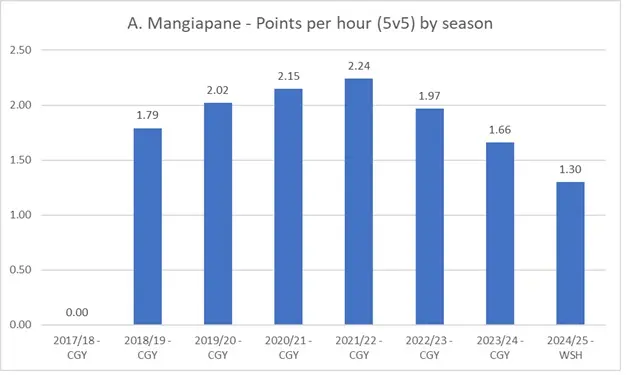
Below is Mangiapane’s rate of points per hour at even-strength (5v5) by season. Since his high point in the 2021-22 season, his production has dropped by about 40 percent. So, while we may look at his last year in Washington as a down-year, it’s part of an overall trend for the player. One caveat to all of this is that he did play predominantly in the bottom six with guys like Lars Eller and Nic Dowd, which would have impacted his productivity. But it does make you wonder why Washington’s coaching staff never had him higher up in the lineup recognizing what his deficiencies were.

.

While the production hasn’t been great, Mangiapane does have a solid track record now of having a positive influence on his team’s ability to outshoot and outchance opposing teams. So, while the productivity might be gradually slipping as he approaches 30, he’s at least helping his team tilt the ice in terms of puck possession and getting into those critical scoring opportunities. His teams always do better with him on the ice than without him, which indicates he could be a helpful play driver across different game situations.

The table below shows Mangiapane’s on-ice shot-differential numbers relative to his teammates. Being above zero means that Mangiapane outperformed the team average, which is impressive considering how strong his previous teams’ underlying shot-share numbers have been in Calgary and Washington. There has been a decline in these on-ice numbers since his wrist injury in 2022/23, but it hasn’t made Mangiapane any sort of liability on the ice. At least not yet.

.

Considering his strong on-ice shot-share numbers, with and without talented players, Mangiapane should probably get a shot in the top six group to see if his production numbers and on-ice goal-share could bounce back. He’s a good replacement for Viktor Arvidsson, who also has a history of helping his team outshoot and outchance opposing teams. But the Oilers should also consider playing Mangiapane away from the star players to help the bottom six control the flow of play and prevent getting outscored when the top stars are on the bench. It’s a constant battle every year for the Oilers to prevent bad things from happening when the McDavid and Draisaitl are off the ice, and this season will be no different. Mangiapane should be able to alleviate these issues.

One other thing to note is that while Bowman did express his vision to have Mangiapane kill penalties, he only played 12 minutes short-handed last year in Washington. And the year prior to that in Calgary, he was barely a secondary option and didn’t post great numbers as the Flames allowed more shots with him on the ice. Something to consider when evaluating his potential roles this upcoming season and managing expectations.

Data: Natural Stat Trick, PuckPedia

Also posted at Oilersnation.

What the Oilers might lose by moving on from Viktor Arvidsson

Fair to say that the Edmonton Oilers front office will have a busy off-season. After a solid playoff run that again fell short, it’s imperative that they apply a critical lens, identify inefficiencies across the roster, and address the gaps to stay competitive.

Based on Stan Bowman’s recent media availability, it appears that the Oilers forward group will get the most attention from the front office. There’s likely going to be a push to shed some older players and make room on the regular roster for the few young prospects in the system. And there’s also the need to clear up cap space to sign key players such as Evan Bouchard and allocate dollars to address the goaltending.

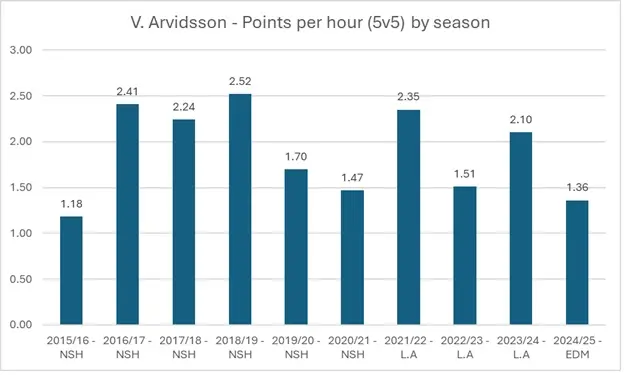
One forward that the Oilers are currently looking to move on from is winger Viktor Arvidsson, as he’s in the last year of his two-year contract that pays $4 million this upcoming season. Arvidsson has had a solid career thus far, putting up 389 points in 612 games over eleven seasons. But this past regular season, his numbers slipped slightly as he put up 15 goals and 12 assists in 66 games (in all situations). At even-strength, Arvidsson ranked eighth among the Oilers forwards in terms of points per hour with 1.36. This was his lowest output since his rookie season.

.

While it does make some sense to reallocate his dollars to address other parts of the roster, it’s important to highlight what the Oilers will lose if/when they trade Arvidsson away.

The first thing that stands out when assessing Arvidsson is the positive impact he tends to have on his team’s ability to control the flow of play and scoring chances. Consistently over his career, his teams tend to do better with him on the ice than without him when it comes to puck possession and expected goals metrics. This past season, for instance, his on-ice Corsi For percentage (55 percent) and Expected Goals For percentage (56 percent) were both fifth best among Oiler forwards behind McDavid, Hyman, Draisaitl and Podkolzin. More on this in a second.

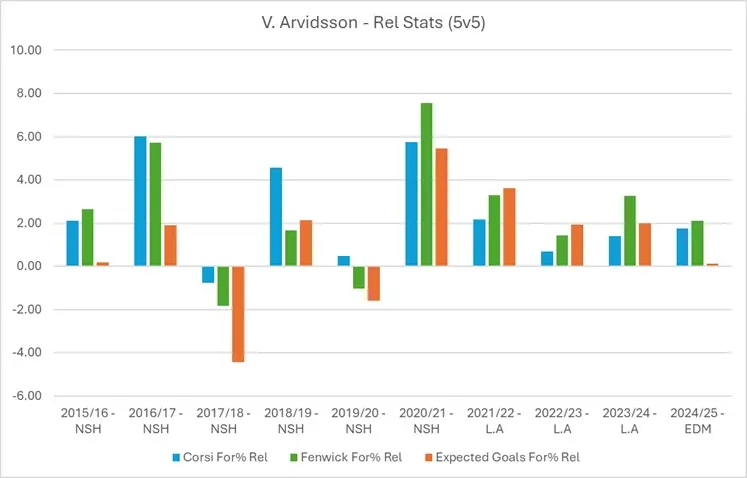
The table below shows Arvidsson’s on-ice shot-differential numbers relative to his teammates. Being above zero means that Arvidsson typically outperformed the team average, which is impressive considering how strong the Oilers’ underlying shot-share numbers were this past season. This trend has continued since his time in Los Angeles, and there doesn’t appear to be a significant drop-off in his performance just yet.

.

Slotting often into the top-six forward group, Arvidsson also played a chunk of his ice time against elite-level opponents and fared quite well. In 203 minutes at even-strength this season, Arvidsson’s Corsi For percentage against elite players was 57 percent – which ranked third among regular Oiler forwards. His Dangerous Fenwick, which is similar to expected goals, was at 59 percent and also one of the best on the team.

And while Arvidsson did play a lot with Draisaitl (394 minutes) and McDavid (82 minutes) at even-strength and posted great on-ice performance numbers with each of them, he also posted great numbers away from them. In 417 minutes without either of the star players on the ice with him this season, Arvidsson posted an on-ice Corsi For percentage of 53 percent and an Expected Goals For percentage of 51 percent. The actual results were a little lacking (48 percent goal-share, -1 goal differential), but that was also impacted by a lower-than-normal PDO of around 96.

One last thing worth pointing out is Arvidsson’s production in this year’s playoffs. He dressed for only 15 of the 22 games and finished 12th in even-strength ice time among forwards (164 minutes). But he did put up two goals and five assists in these limited minutes, which translates into a rate of 2.55 points per hour. That was the second highest among all Oilers forwards, only behind McDavid.

This isn’t to say Arvidsson is a perfect player — he’s not. But there’s going to be gaps that the Oilers will need to address if/when they move him out. He’s a reliable play driver who can play with and without a team’s best players. He can perform well against top-level competition. And he does have a history of relatively good production. These are things that the Oilers are likely cognizant of and will need to factor in when identifying and/or acquiring their replacement(s).

Teams that are considering acquiring Arvidsson would be getting a solid, experienced NHL winger. One that could help elevate a team’s ability to control the flow of play and increase their odds of outscoring opponents. They’d also be getting Arvidsson in a contract year, which could serve as a motivator for the player to keep his focus and hopefully productivity at the highest level. Arvidsson is also coming off a season where his on-ice PDO was close to 96, indicating that in the right situation, his rate of points could bounce back to his career levels. Definitely a buy-low candidate that could pay dividends for a team in tune with his underlying numbers and the Oilers’ desperation.

Data: Natural Stat TrickPuck IQPuckpedia

Also posted at Oilersnation.

Covering Blots: Digging into whether Darnell Nurse has been good enough for the Oilers this season

Defenceman Darnell Nurse has had a lot of highs and lows throughout his season (and career) with the Edmonton Oilers.

Early in the campaign, he posted some of the team’s worst on-ice shot-share numbers and goal-differentials. But by early December we saw his performance and results turn around after the coaching staff played him more often with Leon Draisaitl, who has had an MVP-level season. As the year progressed, Nurse made some great plays and contributed on the score sheet. But that would again be followed up with blunders in his own zone, leading to opponents sustaining pressure and generating scoring chances. His game has recently improved, which is great considering the playoffs are coming up. But it remains to be seen if he can continue playing at this level.

This all led me to a pretty straightforward question: is Darnell Nurse having a good season?

To determine if he meets the threshold of “good”, I produced some basic criteria for a defenceman that is being paid $9 million per year:

  • Must be playing regular minutes against the other team’s top competition at even-strength (5v5), and top minutes on the penalty kill.
  • Must have a positive impact on the team’s shot and scoring chance differentials at even-strength (5v5).
  • Must have a positive impact when playing with the team’s depth players, as in when McDavid and Draisaitl are on the bench.

There could be other criteria, but what I have above are things that correlate to scoring goals and winning games. It’s basically the bare minimum.

Ice-time and Usage

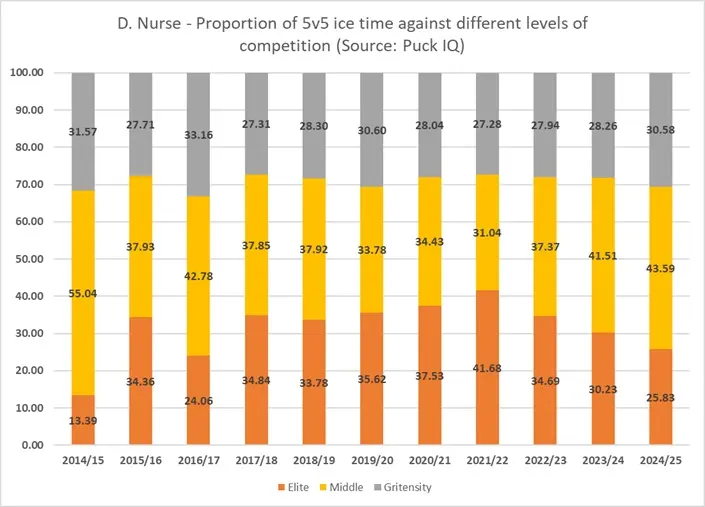
Nurse is currently averaging just under 23 minutes a game this season (in all situations), which ranks third among Oilers defencemen. And he ranks first in the average number of even-strength minutes (19 minutes a game). What’s interesting is that 25 percent of his even-strength minutes this season are against elite competition, according to the methodology used by Puck IQ. This is a drop from last season when Nurse played 30 percent of his minutes against top competition.

The table below shows a steady decline in Nurse’s proportion of ice time against elite-level competition (orange bars) throughout his career, as he was over 40 percent just three seasons ago. The 25 percent proportion he has this season would be one of the lowest in his career, indicating that the coaching staff is well aware of his deficiencies, and are actively trying to put him in a position to succeed.

.

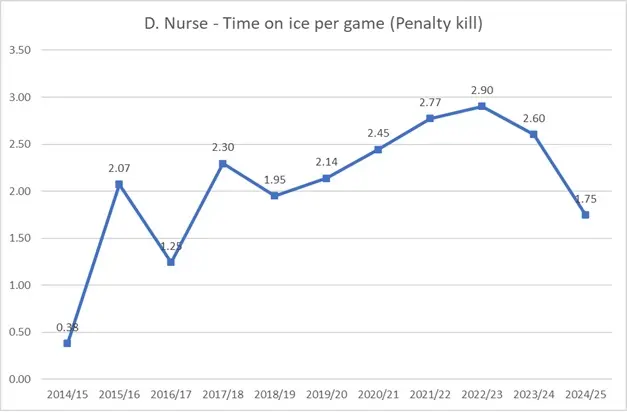
Another thing worth considering is the steady decline in Nurse’s minutes on the penalty kill. Nurse is averaging below two minutes a game this season, which is a significant drop off from the last four seasons when he was regularly on the top penalty-kill unit. The graph below shows his average ice time per season over the course of his career, and is a good indicator of the trust the coaching staff has in the player.

.

Nurse’s Impact at 5v5

Below are Nurse’s relative-to-team shot-differential numbers by season. I tend to use Corsi, a proxy for puck possession, and Fenwick and Expected goals as a proxy for scoring chances.

.

This is going to be the third straight season where the Edmonton Oilers have seen their shot and scoring chances numbers take a hit when Nurse has been on the ice.

Yes, he does play a lot of minutes and sees top competition. But as we saw above, those hard minutes are being reduced. He’s clearly not a player that can be relied on to drive play, and he’ll need to be with a strong defensive partner and high-end forwards as much as possible for him to provide value to the team at even-strength. Which leads to the next criteria.

Impact when playing with depth players

When the Oilers have Nurse on the ice with the depth players, so no McDavid or Draisaitl on the ice, the Oilers have posted some pretty poor performance numbers and results. Their Corsi For percentage and Expected Goals For percentage both drop down to 46 percent when the depth players are playing with Nurse, which, as mentioned above, is why the coaching staff was okay with getting Nurse away from them earlier in the season.

The good news is that the results have been good, with a goal differential of plus-four (goal share of 55 percent), but that’s been largely luck-driven. The team tends to play less often with the puck when Nurse is out there with depth players, so it’s hard to have confidence in these results over the long run.

Final Thoughts

While we sometimes see some great plays from Nurse and his name on the scoresheet, it’s hard to ignore his usage, performance and results over the course of the full season. Expectations are rightfully high for the player, and unfortunately, he’s not meeting some basic criteria that correlates with winning games. The hope is that he can play well into the playoffs, but it’s hard to have confidence when we look at the data over a full season.

Based on his salary and role on the team, you would expect Darnell Nurse to be one of the best defencemen in the league, though you could make the argument that he might not even be the third-best defenceman on the Oilers. That’s a problem for management to address this off-season.

Data: Natural Stat TrickPuckIQ

Also posted at Oilersnation.

The Oilers have gone from red hot to a hot mess

The Edmonton Oilers have been very poor since the 4 Nations Face-Off. In 10 games since the break, they have three wins and seven losses, having been outscored 27-40 in all situations.

Even-strength (5v5) has especially been awful as the club went from a +14 goal differential heading into the break to now sitting at even. Put another way, it took them 55 games to have a goal-share of 53 percent, which was eighth best in the league. And all of that progress, especially what they did in January, has been wiped out in the last ten games. They now rank 18th in the league with a goal share of 50 percent. Not exactly looking like a playoff threat. A graph showing the Oilers cumulative goal differential this season at even-strength is below.

.

The drop-off in results has been driven by their inability to control the flow and their spending less and less time with the puck. Prior to the break, the Oilers had some of the best shot-share numbers in the league, hovering around the 55 percent mark when it came to Corsi percentage (which is a proxy for puck possession) and Expected Goals (which is a proxy for scoring chances). But since the break, these numbers have fallen to league average levels, with their Expected Goals percentage even dropping below 50 percent.

For context, below is the Oilers underlying shot-share metrics in rolling 10-game segments. I’ve added a marker at the 55 game mark, which is the first game after the Four Nations Faceoff tournament. The other low point came around the game 34 mark, which was in late December when the team was struggling. In January, the team turned things around and started playing closer to what was expected. But things appear to have fallen off again. The recent numbers are well below where they were prior to the break and an indication that the tactics and process the coaching staff has in place for even-strength play isn’t working. The results are suffering because of it, and it has to be addressed as soon as possible.

.

There are two issues to consider when trying to understand why these numbers are falling off.

The first is that the team’s goaltending has been a weak spot for the team for a long time now, and hasn’t at any point this season been at or above league average levels. Because of this weakness in net, the team seems to be playing a little too safe now and not pushing for offence as frequently. Instead of taking chances and really leveraging the offensive talent they have up front, there are a few too many conservative plays happening, especially in this recent stretch of games.

The switch to playing more conservatively at even-strength is reflected in the team’s declining rate of generating shot attempts. Before the tournament break, the Oilers were generating 62.6 shot attempts per hour — one of the highest in the league. In the last ten games, that rate has dropped by 8.8 percent to 57.04 shot attempts per hour — which is slightly below league average.  Worth mentioning that the team’s rate of shot attempts against has remained steady all season.

.

And as I wrote about a month ago, the team has also been getting a lot more shots from their defencemen, which isn’t ideal considering the probability of scoring drops off the further you’re away from the net. There appears to be more hesitancy to make plays and take some risks to get the puck moving into high danger scoring areas. Instead, the team is taking shot attempts from distance, and hoping the best for rebounds. This is a weird tactical issue that various coaching staffs have tried in Edmonton, and it just doesn’t work well.

Considering the team’s championship aspirations, and the importance of home-ice, it’s critical that the Oilers coaching staff recognize the issues and make the necessary adjustments. The chase for a division title is slowly slipping away, but there is still time to make some ground.

Data: Natural Stat Trick

Also posted at Oilersnation.
Does the volume of shots the Oilers take from the blueline impact the team’s shooting percentage?

The Edmonton Oilers are in a great spot right now, sitting first in the Pacific with 72 points in 55 games, and two points ahead of Vegas. They rank third in the league with a 0.667 points percentage, only behind Washington and Winnipeg.

A big reason for that is their overall results at even-strength (5v5), where they’ve outscored opponents 120 to 106 and have a goals-for percentage of 53.10 percent that ranks eighth in the league. What’s been especially encouraging is their strong underlying numbers, like their Corsi For percentage and Expected Goals-For Percentage – both of which are around 55 percent and indicate that their results at even strength are real and sustainable.

What’s interesting is that while the team is getting excellent results at five-on-five, the team’s shooting percentage of 8.26 percent is one of the worst in the league. They currently rank 26th and only ahead of Anaheim, Pittsburgh, Detroit, Calgary, Ottawa, and Nashville – none of which are considered cup contenders like Edmonton. Last season the Oilers shooting percentage ranked 15th in the league and the year before it ranked eighth.

Put another way, if the Oilers had a league-average shooting percentage this season (which is around 8.75 percent), they would have scored 125 goals this season instead of 119. That’s another win in the standings and a larger gap between the competition in the Pacific. Natural Stat Trick’s expected goals model also has the Oilers at scoring 132 goals, which again is higher than their actual count. Using that model, the Oilers should have two extra wins in the standings.

Any way you look at it, the Oilers would be higher up in the standings if they could just finish their chances even marginally better. Goal-scoring has been gradually increasing year-over-year league wide, making it even more critical that Edmonton keeps pace to help solidify their ranking and secure home-ice for the playoffs.

There are of course plenty of factors why the Oilers might be underperforming when it comes to goal-scoring. Players can always slump over the course of a year. Maybe teams are just playing the Oilers harder as they went to the final last season and are considered one of the legit Cup contenders. Hard to pinpoint the exact issue.

But one factor that could be driving down the team’s shooting percentage is the high number of shots and the proportion of shots that are coming off the sticks of their defencemen. Ideal scoring chances are from in close and when the goalie is in motion – which is more likely to happen when forwards are getting those opportunities. Shots from the blueline can create rebounds and chaos, but a lot of times a team is just giving up puck possession when they’re shooting from distance.

On average, teams get about 30 percent of their total even-strength shots from their defencemen. This season, the Oilers getting 35 percent of their total shots from their defencemen, which is the third highest proportion in the league. In the previous two seasons, the Oilers were at around 31 percent and closer to league-average levels. Worth noting that the two teams that get a higher proportion of shots from their defencemen are also cup contenders who are struggling with finishing their chances. Carolina currently ranks 19th in the league in terms of shooting percentage while Colorado ranks 22nd.

Back to Edmonton and their rate of shots from defencemen. Among the 252 defencemen who have played at least 100 even-strength minutes this season, Darnell Nurse ranks third highest with 7.20 shots per hour and Evan Bouchard ranks seventh with 6.82 shots per hour. Ekholm isn’t too far behind, ranking 18th with 6.13 shots per hour. No other team has three defencemen in the top twenty.

For additional context, below is a shot-location map from Hockey Viz comparing the Oilers’ chances last season compared to this season. Red indicates a higher volume relative to league average levels. What stands out here is the growth in chances coming from the blueline on the right side. And fewer shots from in close, which the Oilers excelled at last season.

.

Ideally, the shots are coming from the forwards up front, especially from the top-end players. It’s worth noting too that McDavid’s rate of shots are down this season, which is a little baffling considering his talent level and above-average shooting percentage. His current individual rate of 7.51 shots per hour is down 22.1 percent when compared to his rate over the last three seasons (9.17 shots per hour). Unclear if it’s because the defencemen are taking more of the shots or if he’s dealing with something else.

.

As the regular season winds down, there’s going to be a home-ice advantage on the line. And it’ll be critical that the Oilers keep up with the growing scoring pace across the league – especially at even-strength. The team is doing a lot of things right in terms of controlling the flow of play and out-chancing opponents. But unless the coaching staff makes some tactical adjustments and generate more offence from their star players up front, the shooting percentage may not improve to where it should be.

Data: Natural Stat TrickHockey Viz

Also posted at Oilersnation.

The redeployment of Darnell Nurse is leading to some of his best hockey for the Oilers

The Edmonton Oilers made significant progress in November and now have 32 points in 27 games—a points percentage of 0.593 that ranks seventh in the Western Conference and fourth in the division. Their first ten games of the season really set them back (4-5-1), as they were, at one point, 13th in the conference and only ahead of San Jose in the Pacific.

There are plenty of reasons for their resurgence, but one player in particular who has helped turn things around is defenceman Darnell Nurse. He’s been more noticeable recently (for good reasons) making some great plays on Saturday night against St. Louis and helping set up Corey Perry with a nifty pass for the opening goal.

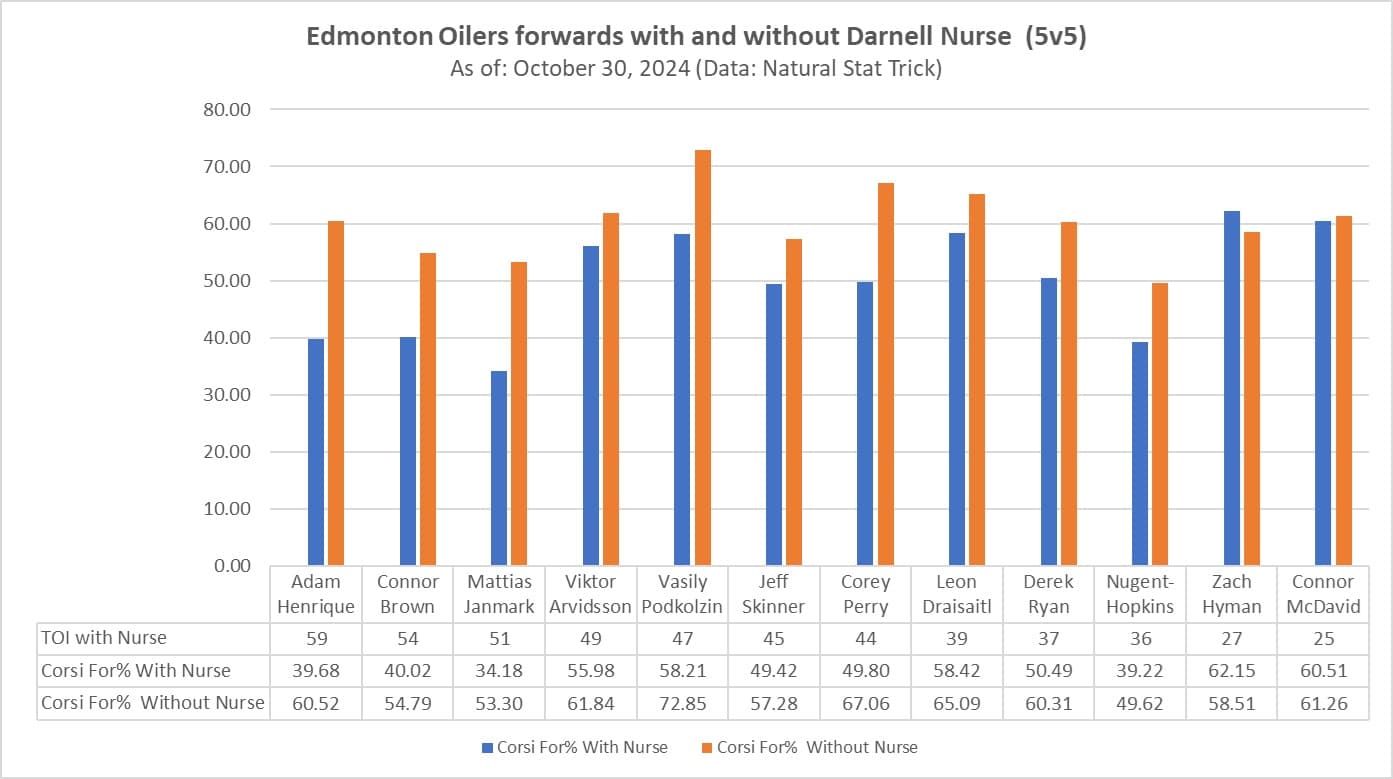
Nurse had really been struggling early on this season, especially at even-strength (5v5). In 171 minutes over the first ten games of the year (up until October 30), he had a 25 percent on-ice goal-share (on the ice for three goals for and nine goals against). And he was posting some of the worst shot-share numbers on the team as opponents would more often outshoot and outchance the Oilers with Nurse on the ice. What really stood out in those first ten games was how almost every forward on the Oilers was posting better on-ice shot-share numbers when they were playing away from him (i.e., without Nurse on the ice), as Nurse’s performance was really dragging his teammates down.

.

Since those first ten games, however, Nurse has been posting significantly better numbers with the team doing a better job controlling the flow of play and scoring chances with him on the ice. His on-ice shot-share numbers at even-strength are all above 53 percent and some of the best numbers on the team. The best part is that his actual results (i.e., goal-share/goal-differentials) have been excellent, as the team has posted a goal-share of 82 percent — nine goals for, two goals against with Nurse on the ice. That goal-share isn’t sustainable and will gradually decline, but his underlying shot-share numbers indicate that the Oilers are more likely to outscore opponents with Nurse on the ice if he continues to perform at this level.

Now this turnaround didn’t happen automatically, and it appears there have been some very strategic adjustments made by the Oilers coaching staff. There’s a lot of pressure on this team this season to win games and make a deep playoff run. And to also maintain the value of their players, especially those on heavy, long-term deals like Nurse. So, it behooves the coaching staff to recognize problems, find potential solutions to improve their odds of winning games and have the courage to carry through on them.

One solution to the Nurse performance problem has been more ice time with Leon Draisaitl.

As I had written about in late October, Nurse played a lot of his even-strength minutes with the depth forwards in the first ten games of the season – specifically the third and fourth lines. Of the 171 minutes Nurse was deployed for, about 35 percent was with Adam Henrique and 32 percent was with the fourth line (basically when McDavid, Draisaitl or Henrique weren’t on the ice). About 23 percent was with Leon Draisaitl and Nurse played the least often with McDavid’s line, as that top line has exclusively been deployed with the Evan Bouchard/Mattias Ekholm pairing – a five-man unit pretty much all season.

Since those first ten games Nurse’s deployment has significantly changed, with more of his time being spent with Draisaitl, and whoever is on the second line, and less time with the third and fourth lines. The table below splits Nurse’s season between his first ten games (up until October 30) and the last fourteen games (between October 31 and December 7). Note that Nurse did miss a few games with a head injury.

.

What we see here is that Nurse’s overall proportion of ice time with Draisaitl has significantly increased from about 23 percent in the first ten games to just under 40 percent in the last fourteen games – essentially creating a second five-man unit for the coaching staff to deploy. Nurse’s proportion of ice time with Henrique has dropped from 34 percent to 26 percent. And his time with the fourth-line players dropped from 33 percent to just under 11 percent.

This re-adjustment of Nurse’s deployment makes a lot of sense as he’s now playing more often with a second line who he was performing well within the first ten games of the season. One of my findings back in late October was that while Nurse dragged the performance numbers of most of the forwards down, his numbers remained respectable with Draisaitl, Podkolzin and Arvidsson – the group that basically formed the second line. So far things are going well as Nurse is not only performing well in his increased minutes with Draisaitl and the second line, but also playing much better in the minutes with the depth players.

It’d be worth asking the Oilers coaching staff if this actually was a strategic plan to help Nurse’s performance numbers improve. And if players like Nurse, who are accustomed to playing with high-end players tend to play down to the level of their linemates. My thought is when a defenceman like Nurse is out with a fourth line, for example, they may be conserving their energy and risk-taking for when they get to play with higher-end linemates, but that’s something a coach or player can speak to.

For now, it’s interesting to see how a coaching staff has adjusted a player’s deployment, and potentially used data and underlying shot-share numbers to assist with decision-making. Recognizing deficiencies, identifying solutions, and having the courage to carry them out is critical for a team pushing for championship. Hopefully, there’s more to come – especially for a roster that hasn’t quite reached its potential yet.

Data: Natural Stat Trick

Also posted at Oilersnation.
Here’s what’s behind Jeff Skinner’s early-season struggles

It’s been a tough start to the season for Edmonton Oilers forward Jeff Skinner.

In his first seventeen games since signing a one-year, $3 million deal with the Oilers in the summer, Skinner has scored three goals and made three assists, all at even-strength. His on-ice goal-differential at even-strength is currently -5 (6 goals for, 11 goals against), which translates to a 35 percent goals-for percentage that currently ranks second last among Edmonton’s forwards. Considering he’s played the sixth most minutes on the team (217) and ranks sixth in average ice time per game at even-strength (12.79), his results are a problem that’s hard to ignore.

Over the last few games, the coaching staff has started to sit Skinner more often at even-strength. In the last two games, Skinner has averaged less than nine minutes, which is about 17 percent of the Oilers total even-strength time.  That’s well below the previous fifteen games where he’s averaged about 13 minutes a game, and 26 percent of the Oilers total even-strength time. The table below shows Skinner’s proportion of ice time per game in blue and the actual ice time per game in orange.

A graph showing how Jeff Skinner's ice time and proportion of ice as an Edmonton Oiler has been gradually declining at even-strength.

.

There are a couple of major issues with Skinner that have likely played a role in his decreased ice time.

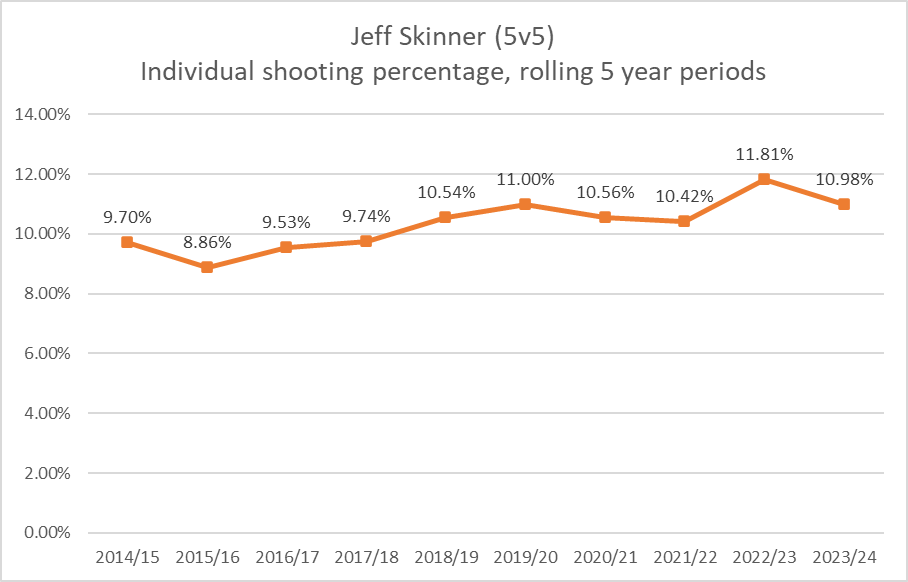
One, Skinner just isn’t producing at the level and consistency that management was probably expecting from him. He’s scored three times on 44 shots so far – which is a shooting percentage of 6.82 percent. That’s well below the 10.98 shooting percentage he’s posted over his previous five regular seasons, and the 10.65 percent he’s posted over his fourteen-year career.  The Oilers are currently near the bottom of the league in terms of team shooting percentage (6.68 percent) and are relying on Skinner to help turn those even-strength results around.

.

The other issue is that Skinner’s on-ice numbers at even-strength, relative to his team’s numbers, have been poor so far. Corsi (or shot attempts) and Expected Goals help us understand how well the team does at controlling the flow of play and out-chancing opponents with specific players on the ice. And it helps us uncover who could be helping drive play and opportunities for a team, and who might be dragging the team down.

Skinner would currently fall under this latter category as the team is posting an Expected Goals For percentage of 52.45 percent with him on the ice, which isn’t bad. But his team’s share of Expected Goals jumps to 57.98 percent when he’s on the bench. Below is a table with all of the Oilers’ forwards on-ice relative to team numbers, sorted by average ice time per game. A basic heat map is applied to each metric (green is good, red is bad) to give a sense of how each player compares to their teammates.

A table showing each Edmonton Oilers forward's relative to team numbers at even-strength this season.

.

One issue with Skinner is that the team allows a significantly higher number of shots and chances against whenever he’s on the ice. For instance, without him on the ice, the Oilers allow about 23 shots against per hour. But when Skinner is on the ice, this rate jumps by about 25% to 30 shots against per hour. He’s one of the worst defensive forwards on the team, which isn’t overly surprising considering his previous teams have often allowed more shots when he’s on the ice. The difference in prior seasons was that he would help drive more offence and generate chances. But since he’s not having the same impact and the fact that his shooting percentage is down, he’s not providing a whole lot of value for the Oilers.

Worth noting that Ryan Nugent-Hopkins is also posting similar on-ice numbers as Skinner at even-strength, as the team tends to see a lot of chances against when he’s deployed. And it should probably be addressed by the coaching staff, considering he gets a lot of time in the top six with the star players. But because Nugent-Hopkins is on the first powerplay and kills penalties and has a +1 goal differential at even-strength, his underlying issues are likely going to be overlooked. At least for now.

As for Skinner, it’s understandable why the coaching staff has recently cut his minutes. His defensive play this season has been an ongoing issue, and it’s not just a couple of bad plays here and there that have led to this situation. Hopefully, there’s a plan in place to squeeze as much value out of Skinner as possible. But there’s also the harsh reality that Skinner’s defensive play has been a long-term issue over his previous seasons. And considering his age and the fact that he’s played over 1,000 NHL games, it’s hard to expect his defensive numbers to improve anytime soon.

Data: Natural Stat Trick

Also posted at Oilersnation.