Had the chance to do radio and television for CBC Edmonton this evening to talk about the Edmonton Oilers and their upcoming final round against the Florida Panthers. Full radio segment with Min Dhariwal is here: CBC Radio Active (2024, June 3)
The key drivers for the Oilers success in the post-season, including their star players and their penalty kill.
What went wrong with Dallas and what their main challenges were.
The challenges the Oilers have gone through this season, and what adjustments they made along the way.
The key decisions made by the coaching staff that’s helped pushed the team along, including the goaltending and tweaks to the line combinations.
The emergence of Broberg, and the pressure of being only one of two prospects that have been drafted and developed since Ken Holland became general manager.
The Florida Panthers, their strengths and what’s gotten them this far in the playoffs, two years in a row.
Big thank you to the team at CBC for putting the radio and television segments together!
Heading into game five of the western conference series, here’s how the Edmonton Oilers and Dallas Stars have compared so far at even-strength (5v5).
While the number of goals have been even, the Oilers are posting better performance numbers. Over the four games, the Oilers have posted a Corsi For percentage of 56 percent and an Expected Goals For percentage of 54 percent. But Dallas is getting more saves right now, and converting on more of their chances. Edmonton’s shooting percentage is slightly higher than what they posted during the regular season (8.81 percent). It’s their goaltending that’s been below league average at even-strength, and it needs to be better for the Oilers to have a chance of making the finals.
Worth noting that it’s the Oilers depth players that are having issues scoring goals. With McDavid on the ice, the Oilers have outscored Dallas 7-4. But without him on the ice, they’ve been outscored 3-6. The other lines are doing a good job at controlling the flow of play and creating chances. But the team shooting percentage is only 5.45 percent.
The good news for Edmonton is that Dallas’ goaltending isn’t anything special either right now, which isn’t overly surprising. Oettinger played over 3,000 minutes during the regular season, similar to Skinner, and posted an identical save percentage – 90.70 percent in all situations.
On special teams, neither club has scored a powerplay goal. The Oilers have somehow only had 10 minutes of powerplay time in four games, but have done quite well at generating shots and chances. So it feels like it’s a matter of time before it becomes a factor again. The good news is that the Oilers penalty kill has continued to excel, not only continuing to prevent shots and chances, but also scoring a shorthanded goal in game four.
It’s fair to expect the Oilers penalty kill to continue having success, as long as the goaltending remains steady. The Oilers have allowed only three goals in sixteen playoff games so far, largely due to the fact that they’re allowing the second lowest rate of shots against (38.08 per hour) and unblocked shot attempts against (58.64 per hour). These shot suppression rates align pretty closely with what the Oilers posted during the regular season. The difference was that the Oilers weren’t consistently getting league-average goaltending when shorthanded – posting the sixth worst save percentage in the league. So as long as they can get league-average goaltending, we can expect the Oilers penalty kill to continue dominating.
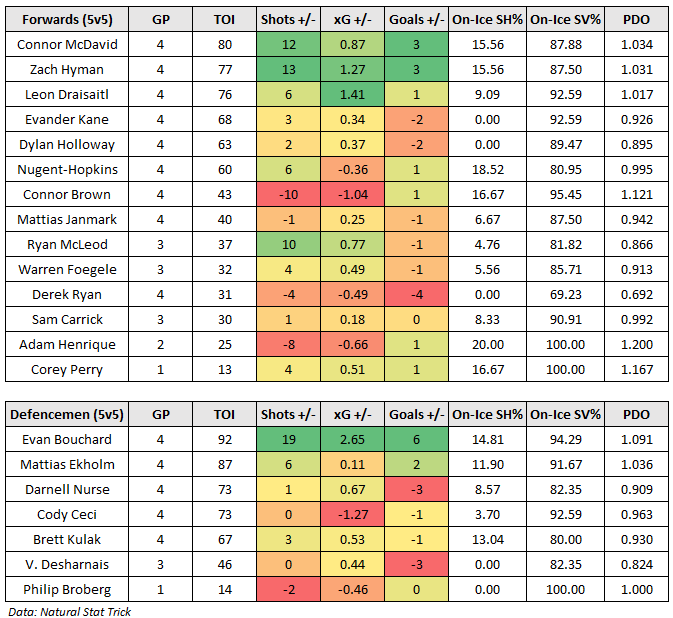
Below is a snapshot at how the Oilers skaters are performing against Dallas at even-strength, including their on-ice shot-differentials and results.
The top end of the roster is doing quite well, with McDavid, Hyman and Bouchard spending a lot of time in the offensive zone and getting good results – and often against Dallas’ top players. I was a little surprised to see Ekholm’s numbers slip this series, as he’s consistently posted excellent on-ice numbers, so it’s likely that he’s dealing with an injury now.
Couple players to keep an eye on up front and on the back end. Brown, while being good on the penalty kill this series, isn’t getting much done at even-strength against the Stars depth players. Henrique is another player who has shown his value at times, but the Oilers tend to get out shot when he’s been on the ice. On the flip side, the Oilers might not be getting individual production from McLeod. But with the right linemates, like he has right now, his results should improve. On the backend, I think I’ve written enough about Ceci for a few years now. So it’s not surprising that he’s posting some of the worst shot-share numbers in the league.
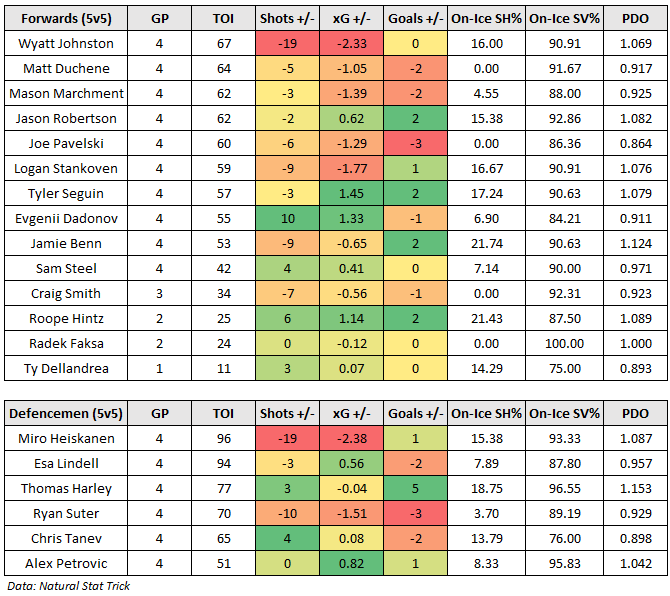
And here’s a quick glance of the Stars. My main takeaway is that the Oilers top end players are taking care of the Stars top end players. It’s the Stars depth players who are making the biggest impact, making the line combination decisions even more important.
Looking forward to what should be an entertaining western conference final between the Edmonton Oilers and Dallas Stars.
Both clubs had great generated plenty of offence in the regular season, each consistently near the top of the league in terms of shot and scoring chance rates in all situations. And that translated into plenty of goals, with Dallas finishing with the third highest rate of goals per hour (3.54) and Edmonton finishing fourth (3.53). Both teams also had excellent results on the powerplay, with Edmonton finishing with the second highest rate of goals (10.53 per hour), while Dallas finished fifth (9.15 per hour). And a lot of their strengths from the regular season are transferring to the playoffs.
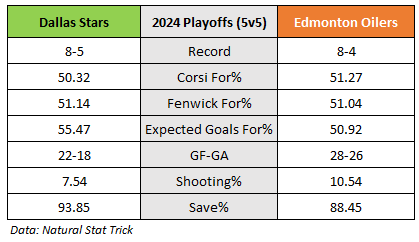
Here’s how both teams have performed so far in the 2024 playoffs at even-strength. Pretty evenly matched clubs, with Dallas having the upper-hand when it comes to goaltending. Dallas appears to be struggling to score goals, which is a little odd considering their shooting percentage over the regular season was one the best in the western conference (9.33 percent). Should note, however, that over the final twenty five games of their season, the Stars did see their shooting percentage slip a little, so maybe we shouldn’t be too surprised.
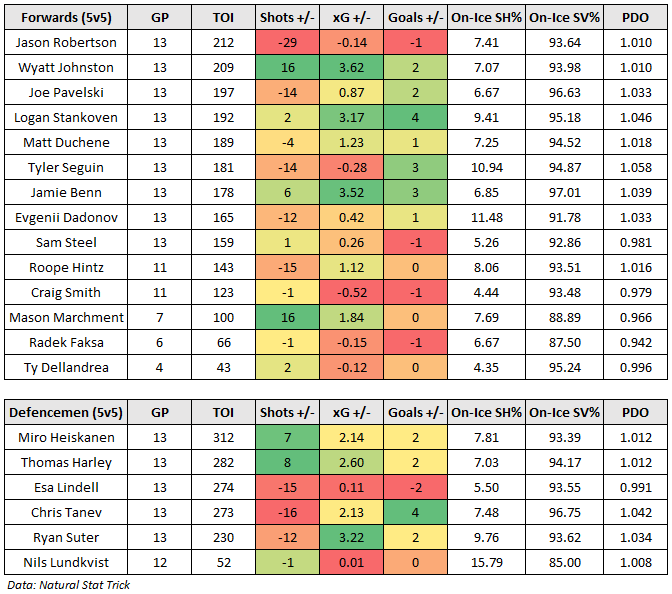
And here’s a quick glance at how the Dallas Stars skaters have performed in their first two rounds.
Interesting to note that while Tanev is having excellent results, he and Lindell could potentially be exploited by the Oilers top line players as the Stars tend to allow a lot of shots and chances with them on the ice. The Stars top defensive pairing is going to be lethal, so I’m curious to see how Knoblauch runs the forward lines with last change at home in games three and four.
Once the Oilers acquired winger Lauri Korpikoski for Boyd Gordon, I figured there’d be no chance of Horcoff returning. The Oilers left wing roster chart was filled before the free agency window opened with Hall, Pouliot, Hendricks, Pakarinen and now Korpikoski signed to play next season. Horcoff had success as a center for the Oilers, but in his past two seasons, he’s been primarily a winger in Dallas.
The Ducks, it appears, have signed him as a centerman. Their left wing roster already has Perry, Maroon, Sekac and now Hagelin who was acquired from New York. Down the middle is where they’ll likely use Horcoff as Nate Thompson is out until December. Ahead of him will be Getzlaf, Kesler and young Rickard Rakell, who the Ducks are probably looking to develop over the next year as he heads into restricted free agency.
It’s obvious Horcoff really wanted to join a cup contender for next season, which is fair considering his age. He’s likely to start as the third/fourth line center until December when Thompson comes back, and then be fighting for a roster spot.. It’s a good, low risk signing for the Ducks, who have added experience to their roster and have flexibility setting their lines.
It’s worth noting that the Ducks replaced Beleskey’s production on left wing with relatively cheaper options in Horcoff and Hagelin, who were both productive last season for Dallas and New York, respectively. (Oddly enough, Beleksey appeared in my list of comparables in my last post on Horcoff). Here’s how all three did at even-strength, when the score was close (Source: War on Ice).
2014-2015, Even-strength, Score Close
Statistic
M. Beleskey (ANA) LW
S. Horcoff (DAL) LW/C
C. Hagelin (NYR) LW
Games
65
76
82
Goals
12
5
10
Assists
7
11
12
Points
19
16
22
TOI/Game
7.65
6.20
7.70
Points/60
2.29
2.04
2.09
Player Shooting %
15.79
12.20
11.36
Zone Starts (Offensive)%
51.44
50.55
48.44
ZSO%Rel
2.54
0.11
-2.30
Corsi For%
53.22
53.13
49.21
CF%Rel
3.09
1.02
-0.72
Scoring Chances For%
53.85
57.08
48.43
SCF%Rel
2.46
4.79
-2.46
Shots For%
51.22
52.20
49.92
SF%Rel
0.47
0.04
-1.27
Not bad potential replacements, considering the cost. Hagelin played mostly with JT Miller and Kevin Hayes in New York, and my guess is he’ll play with Kesler and Silfverberg, who were often Beleskey’s linemates (Source: Hockey Analysis). Haglelin had slightly more points this past season, but his possession stats and shot-share don’t show too well. Horcoff is definitely nearing the end of his career, but he’s a nice option for the Ducks who should be at the top of the division again this season.
The host of the Oilers’ radio broadcast recently tweeted some misleading information regarding sophomore Nail Yakupov.
First off, the plus/minus stat is an extremely poor method of measuring a player’s performance. Yakupov, without a doubt, is struggling this year. With only nine goals, and eight assists so far, it’s clear he’s well off the pace he set last year. But tacking on a statistic that rewards and punishes players who may have nothing to do with the goal scored is just bad reporting. Other factors that can drive a player’s plus minus down include shoddy goaltending, unlucky bounces and empty net goals.
David Staples of Cult of Hockey put together a nice piece on why the plus/minus stat lacks credibility:
In a five year study — compiled through game in, game out video analysis of every goal scored for and against the Edmonton Oilers from 2008 to 2013 — it’s apparent that on goals for, about 70 per cent of the plus marks are correctly assigned to players who make some contribution, major or minor, to the goal. But 30 per cent of the plus marks are awarded to players who make little or no contribution at all to the goal being scored.
Wilkins’ tweet also comes after a game in which Yakupov, I thought, played pretty well. Against the Stars, Yakupov made some great plays, including a couple hits that lead to a nice scoring chance for the Oilers. He set up Gagner late in the game for a decent scoring chance as well.
Bruce McCurdy of Cult of Hockey provided this summary of Yakupov’s game. A lot of positives, but unfortunately they get overshadowed by misleading stats like plus/minus.
#64 Nail Yakupov, 5. Some good, some bad. Proactive without the puck, and was credited with 3 hits and 3 takeaways. Had one good sequence when he hit Sergei Gonchar on the end boards, stole the puck, walked out for a decent backhand shot, then when Gonchar recovered the rebound chased him down and hit him again. Made one nifty steal for an apparent chance only to bobble it away. Later broke his stick on an attempted one-timer of a nice Hemsky set-up. Made a soft pass to a covered Eberle which resulted in the jailbreak on the 2-1 goal that put the Stars ahead to stay. Wound up -2 after being out for the empty-netter as well, which put him at a frigid -30 on the year, by far the worst in the NHL.
I get that Yakupov is struggling, but let’s not suggest he’ll approach the record for worst plus/minus. Keep the reporting fair and put the right information into the right context.
+/- can be misleading. Yak did have a decent game Tuesday. A couple of listeners asked if he could break the all-time record. I provided that stat. Never suggested he would approach the record. Rob and I discussed +/- on the call in show. I don’t feel I did any unfair reporting.



 The SuperFan