After a really nice stretch of success on the penalty kill, which I had just wrote about recently, things have really taken a turn for the Edmonton Oilers since the NHL All-Star break.
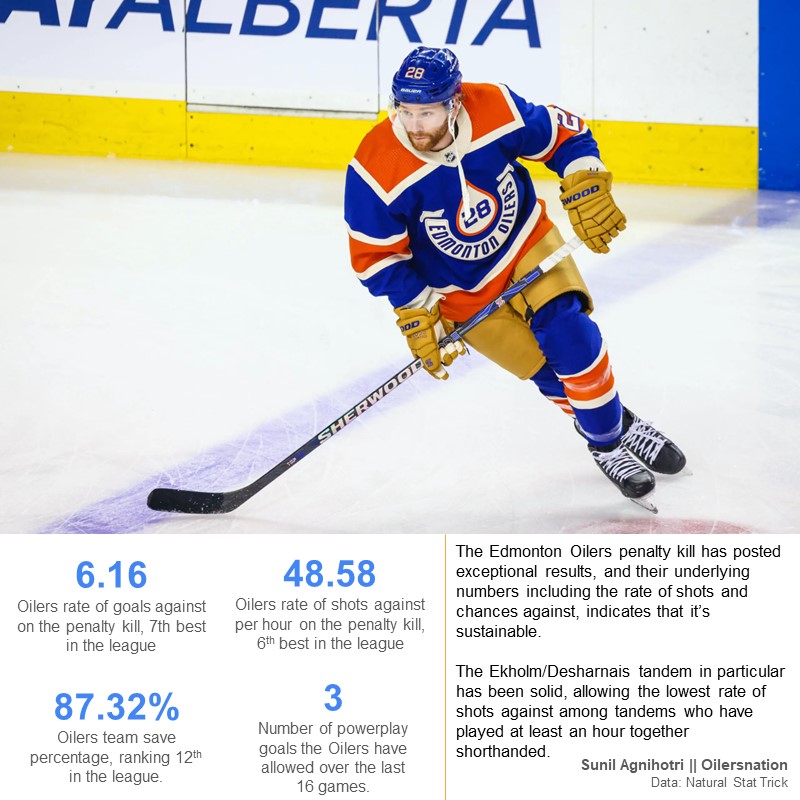
A big reason for the Oilers penalty kill success in the first 45 games of the season was their ability to suppress shot attempts and shots on goal. They allowed the third-lowest rate of unblocked shot attempts (66.83 per hour) and the sixth-lowest rate of shots against (48.58 per hour). And the shots that did get through were stopped 87.32 percent of the time, which was right around league average.
But in the ten games since the All-Star break, the rate of shots and chances against has increased significantly. For instance, the rate of shots on goal has increased by 36.1 percent, going from 48.58 per hour to 66.10 per hour. And what’s made things worse is that the goaltending isn’t nearly as good as it was earlier in the season, with the team save percentage dropping by 10.9 percent, so the skaters aren’t getting bailed out when mistakes are happening.
The Edmonton Oilers powerplay continues to be near the top of the National Hockey League when it comes to scoring efficiency, ranking second in the league only behind Tampa Bay with 11.14 goals per hour. This is largely driven by their high-end talent who help generate the fifth highest rate of unblocked shot attempts (91.49 per hour) and the second highest rate of actual shots on goal (66.83 per hour). And their team shooting percentage sits at 16.67 percent. The Oilers actual results this season are right in line with where they’ve been over the last three seasons where they’ve posted 11.28 goals per hour between 2020/21 and 2022/23, which translates to a 17.40 percent shooting percentage.
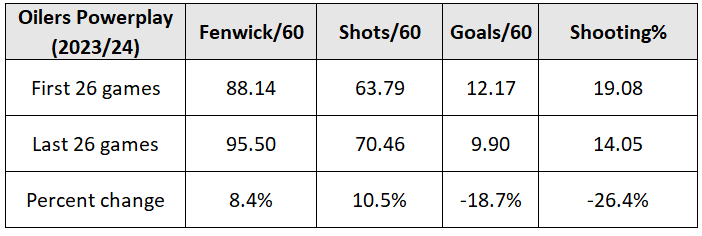
What’s worth noting is that while the results over the full season have been excellent so far, the team’s productivity has slipped slightly over the course of the season. If we split the current 52-game season in half, we see that the finishing ability of the powerplay is down a few percentage points going from 19.08% in the first 26 games, to 14.05% in the most recent 26 games. This has resulted in the goals scoring rate dropping from 12.17 goals per hour in the first half of the season to 9.90 goals per hour in the second half.
It might feel like things are worse than they actually are based on the couple games where the powerplay didn’t score and how players are reacting on the bench shortly afterwards. But the team is still generating plenty of chances, actually seeing a 10.5 percent increase in their rate of shots when comparing the two segments. And they’re still in the range of the shooting percentage we can reasonably expect them to be at (17.40 percent). My guess is that over the last 30 games of the season, we’ll see their shooting percentage bounce back up to where it should be, and things should be calmer.
The reality is that the Oilers have set very lofty standards for their powerplay, and there’s a lot of pressure that’s been built up because of the team’s inability to win titles with such high-end talent on the roster. The powerplay is a massive weapon for the Oilers and it appears the coaching staff is doing everything they can to maximize its output. Over the last 26 games, the first powerplay unit (using Evan Bouchard as the proxy) has played 80.6 percent of the team’s powerplay time – an increase of 6.60 percentage points from the first 26 games of the season where they played 74.0 percent of the total time The first powerplay has responded well to the additional responsibility, generating even more shots in the more recent stretch of games. Their rate of shots on goal has increased by 19.0% from the first 26 games of the season, going from 64.81 shots per hour to 77.15 per hour. So it should be a matter of time before the powerplay heats up again.
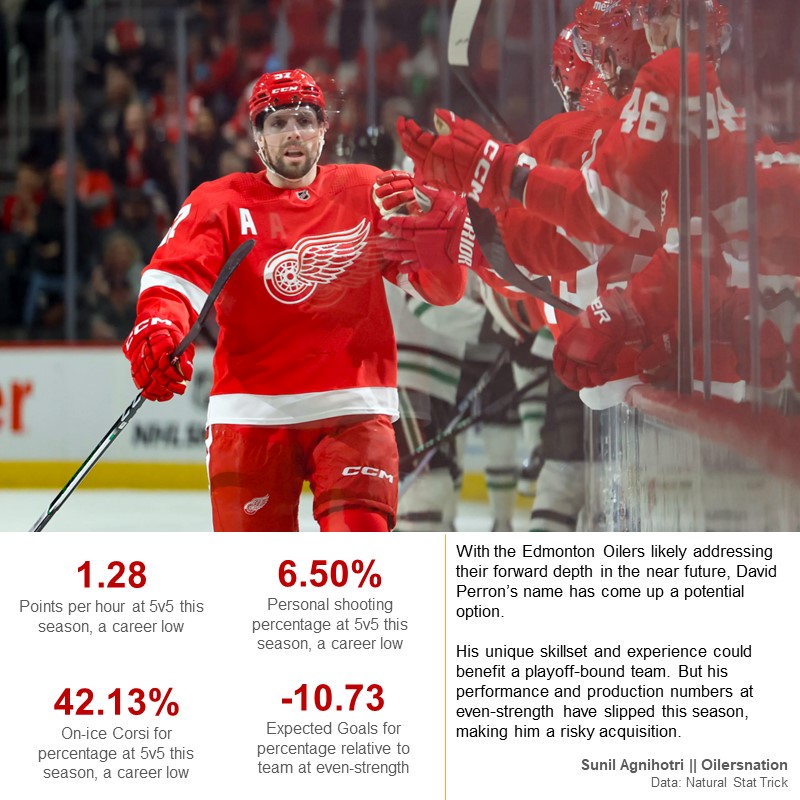
With the Oilers needing to address their depth scoring up front, I reviewed David Perron’s performance and production numbers to see if he could be an acquisition option. Long time fan of his game (and his white skates), but unfortunately it looks like his play has declined.
Perron’s inability to finish chances and his drop in personal production could be blamed on the fact that he’s playing further down the lineup with lesser-skilled linemates. But his poor production is also due to the fact that the Red Wings often spend more time without the puck and in their own zone whenever Perron is on the ice. Again, this is something Perron used to excel at over his career as he often helped drive his team’s ability to out-shoot and out-chance opponents. But it appears the forward has lost a step this season as his relative-t0-team numbers have been in the negatives, indicating that he may be a drag to his team instead of a driver like he used to be.
Remarkable results for the Edmonton Oilers, posting 16 straight wins over a 37 day stretch between December 21, 2023 and January 27, 2024.
The Oilers outscored opponents 43-20, a 68.25 percent goals-for percentage, at even-strength (5v5). A big reason for their results was their ability to control the flow of play and generate scoring chances consistently. They posted a Corsi For percentage of 55.91 percent and Expected Goals For percentage of 57.31 percent.
The Oilers team save percentage was 94.01 percent, third highest in the league. In all situations, the Oilers had the best save percentage in the league with 94.56 percent.
The Oilers powerplay scored 11 goals, a rate of 10.68 goals per hour that ranked fifth in the league for this time period. Their rate of shots (69.92 per hour) and unblocked shot attempts (94.20 per hour) ranked fourth and fifth in the league, respectively. Their powerplay shooting percentage was 15.28 percent and ranked 14th in the league.
The Oilers penalty kill only allowed 3 goals, a rate of 2.18 goals against per hour – the lowest in the league. They allowed the second-lowest rate of unblocked shot attempts (62.63 per hour) and the fourth lowest rate of shots against (45.88 per hour). I did a deeper dive on the Oilers penalty kill recently for Oilersnation.
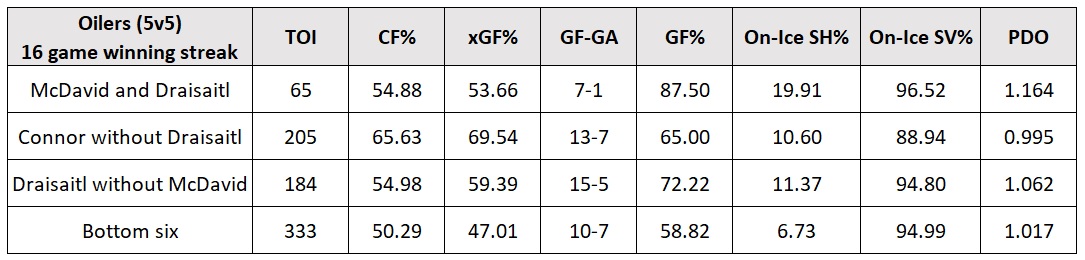
The Oilers dominance was really driven by their top six group, featuring McDavid and Draisaitl. With either of them or both on the ice, the Oilers were at another level, spending a lot of time with the puck and in the opponents zone – which led to a lot of scoring chances.
The share of expected goals, which factors in shot quality, took a massive jump during this winning streak with McDavid on the ice, as his line with Hyman and RNH has been dominant for a few months now. Draisaitl posted excellent numbers as well, especially with McLeod and Foegele. Not much to complain about how the top six has performed.
The bottom six group had some issues at even-strength. While they did post a positive goal differential, it appears a lot of their success was dependent on the goaltending. Without McDavid or Draisaitl on the ice, so 333 minutes which equates to about 42% of the team’s total time spent at even-strength, the Oilers posted a Corsi For percentage of only 50 percent and an expected goals for percentage of 47 percent. That’s well below their team levels this season, and makes you wonder if this bottom six is up for the task when playoffs roll around.
Below is a high-level snapshot of how each player’s on-ice numbers were at even-strength (5v5) during the 16-game winning streak, split between forwards and defencemen and sorted by total ice-time. Included are the metrics I use to assess a player’s performance (i.e., shots and expected goals) as well as their actual on-ice results (i.e., goal differential). I’ve also included each player’s PDO, which assesses how lucky/unlucky they’ve been, and if we can expect their results to improve over the course of the season. A basic heat map has been applied to show how each player compares to the rest of their squad.
Interesting to see that Kane only broke even in terms of on-ice goal differential during this 16-game winning streak. Even Brown was +2. Considering how much time Kane got to spend in the top six, especially after publicly complaining about his ice time, you’d expect his numbers to be a little stronger. And somehow Derek Ryan posted a -2 goal differential. On the back end, it was really that top pairing of Bouchard and Ekholm that helped drive results. Should be interesting to see how the Oilers address their issues among the depth forwards up front and on the right side of their defensive group.
With the Edmonton Oiler’s penalty kill posting excellent results, I thought it would be worth digging into the underlying performance numbers to see if the results are sustainable. And which individual players have been the drivers this season.
The Mattias Ekholm and Vincent Desharnais tandem on the blue line has been very good together, posting a rate of 33.45 shot attempts against per hour in 65 minutes together this season. Among 34 defence pairings who have played at least an hour together on the penalty kill, they rank first in terms of shots and unblocked shot attempts against. The average rate of shots against among these 34 defence pairings is 56.89 per hour, so they’re well below that level.
It is worth noting, too, that while the Oilers see an increase in shots and chances against Darnell Nurse and Cody Ceci on the ice together, their actual rate of shots and chances are still just under league-average levels. That’s pretty solid considering they’re often playing against the other team’s top powerplay units. The tandem has played 101 minutes together on the penalty kill, which ranks 12th highest in the league.
Looking at the forwards, you can tell who’s been playing more often on the second penalty kill unit with the Ekholm/Desharnais tandem based on the green boxes. Connor Brown, for example, has posted excellent numbers and is a big reason why the Oilers have done a nice job suppressing chances. He’s been much maligned this season due to his poor play at even strength, which has led to demotions in the lineup and some time in the press box. But there’s no denying his contributions to the second unit. After his signing last summer, I had looked into his penalty kill numbers which were fine overall, but took a bit of a hit whenever he’d play on the top units in Ottawa and Toronto. Nice to see that the coaching staff recognized his strengths and weaknesses and put him in a position to succeed.
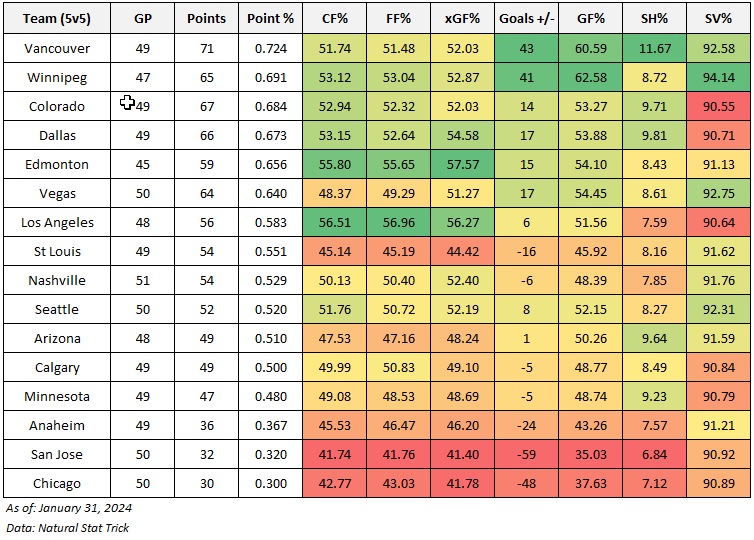
It’s wild to think of the progress the Edmonton Oilers have made since my last check-in at the end of December. At that point, they were “within striking distance of a wild-card spot”, and now they’re sitting comfortably near the top of the Pacific division. A 16-game winning streak, including an 11-0 run in the month of January, can do wonders. And it also shows you what it actually takes to make ground in the NHL standings. After 45 games, the Oilers now have a points percentage of 0.656 – which has them second in the Pacific division and fifth best in the western conference.
Below are the even-strength (5v5) numbers for each team in the western conference (sorted by points percentage), including goal-share results as well as the shot-share metrics that give us a sense of which teams have the right processes in place and if the results are sustainable or not. At the end of the table are each team’s shooting percentage and save percentage. I’ve also applied a basic heat map to each metric to show which teams are doing well or struggling relative to their conference foes (i.e., green is good, red is bad). You can also find a description of each metric at the end of this article. Please note that the shot-share metrics are score and venue-adjusted based on Natural Stat Trick’sTrick’s methodology.
Not much to say about the Oilers right now. Everything is clicking thanks to their strong play at even-strength where they’ve posted a Corsi For percentage of 55.80% this season (fourth highest in the league) and 55.91% over this current 16-game winning streak. Outside of a couple games where they probably should have lost, they’ve looked really good during this win streak, getting plenty of contributions from across the roster. Powerplay is doing well and the penalty kill has been one of the best in the league.
Couple other observations of the western conference:
Colorado’s goaltending should be a spot of bother for them, as they rank near the bottom of the western conference with a 90.55% team save percentage. I do wonder if giving Alexander Georgiev the highest workload in the league is going to cost Colorado down the stretch and in the playoffs. They seem to be doing everything else right, getting positive results driven by their strong possession numbers. But I’m guessing they’ll aggressively try to find a stronger goalie who can play a lot of minutes.
Los Angeles is in a similar situation, having overplayed Cam Talbot, and now they’re reeling just a bit. Thought Todd McLellan would have learned his lesson when he was coaching the Oilers in the 2016/17 season.
Vegas isn’t looking as strong as the rest of the teams at the top right now, posting some of the lowest shot-share metrics in the group. But they do a good job balancing their goalies workloads and are getting positive results from them.
Edmonton is still around league average when it comes to shooting percentage and save percentage at even-strength over the course of the full season. Funny how everything is balancing out like some of us suspected.
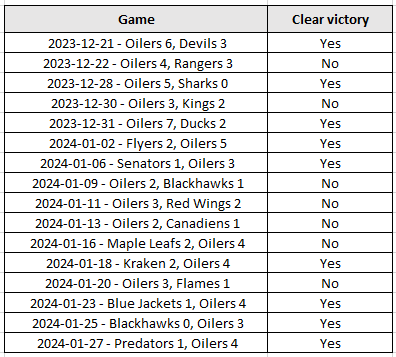
A concept I’ve been thinking more about are “clear victories”, and how many the Oilers have secured this season. It’s a concept that Scott Reynolds and Derek Zona of the Copper & Blue tracked back in the day, and it was defined by any win by two or more goals without empty-net goals needed. Clear victories measure a team’s talent better than the win-loss record, and gives us a better idea of which team could have sustainable success. If your team is winning a bunch of one-goal games or needing overtime, chances are that over time, those will eventually turn to losses. But if your team is putting teams away early on in the game, it’s a good sign that they’re roster is talented and that the wins should carry forward.
The good news for the Oilers is that over this 16-game winning streak, nine have been clear victories. They did have a stretch of six wins where only one was a clear victory, which made me think a loss was coming soon. But then they put up three straight right before the NHL all-star break.
Challenge right now is getting that specific data set over multiple seasons. I do have something in the works to not only see how the Oilers are doing when it comes to clear victories, but also how they compare to other teams who have won playoff rounds. Hoping to have something together soon.
Points-percentage (Point%) – The total points accumulated divided by the points that were available, including extra time.
Corsi for percentage (CF%) – The proportion of all the shot attempts the team generated and allowed that the team generated (i.e., corsi for/(corsi for + corsi against). This is used as a proxy for possession and is the best at predicting a team’steam’s future share of goals (GF%). (Source: Hockey Great Tapes – Draglikepull)
Fenwick for percentage (FF%) – The proportion of all the unblocked shot attempts the team generated and allowed that the team generated (i.e., Fenwick for/(Fenwick for + aenwick against). This is used as a proxy for shot quality and considers shot blocking a repeatable skill.
Expected goals for percentage (xGF%) – This is a weighting placed on every unblocked shot based on the probability of the shot becoming a goal. This depends on the type of shot, location and uses historical shot and goals data to come up with the probability for each unblocked shot.
Goals for percentage (GF%) – The proportion of all the goals that the team scored and allowed that the team generated (i.e., Goals for/(Goals for + goals against).
Shooting percentage (SH%) – The percentage of the team’steam’s shots on goal that became goals (i.e., total goals divided by the total shots on goal).
Save percentage (SV%) – The percentage of the team’steam’s shots on goal against that were saved (i.e., 1-(totals goals allowed divided by the total shots on goal against)).
In my latest post for Oilersnation, I looked into Stuart Skinner’s workload so far this season, and how his proportion of the team’s total ice time compares with other goaltenders.
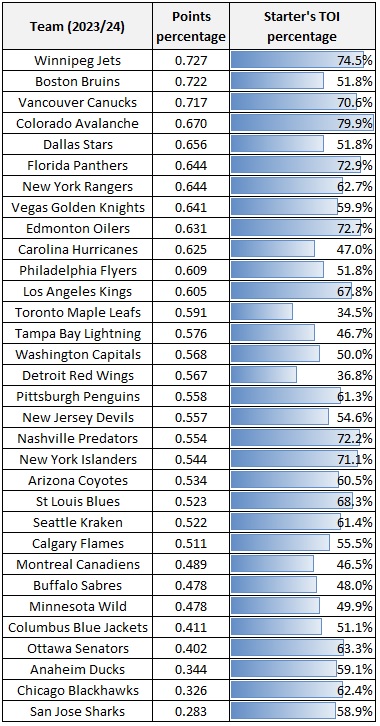
The concern with Skinner is that while he’s been very good for the Oilers, his workload remains one of the highest in the league. He’s played 1,847 minutes in total this season, which is the seventh-highest in the league. With Jack Campbell in the AHL and Calvin Pickard only getting a handful of starts, Skinner has now played 72.7 percent of the Oilers’ total ice time this season, which is the fourth-highest proportion in the league. He’s only behind Alexandar Georgiev (79.9 percent in Colorado), Connor Hellebuyck (74.5 percent in Winnipeg) and Sergei Bobrovsky (72.9 percent in Florida).
The concern for the Oilers is that with one of the hardest travel schedules, the overall grind of the regular season and the lack of options in net, there’s a very real possibility that Skinner won’t be as rested and fresh as some of the others when the playoffs start. With 40 games left in their schedule, the Oilers really need someone to play at least half of them, so that Skinner finishes the season with about 52 games. This would still be higher than last year’s league average number of games for a starting goalie (47), but would at least be lower than the 61-game pace he’s currently on.
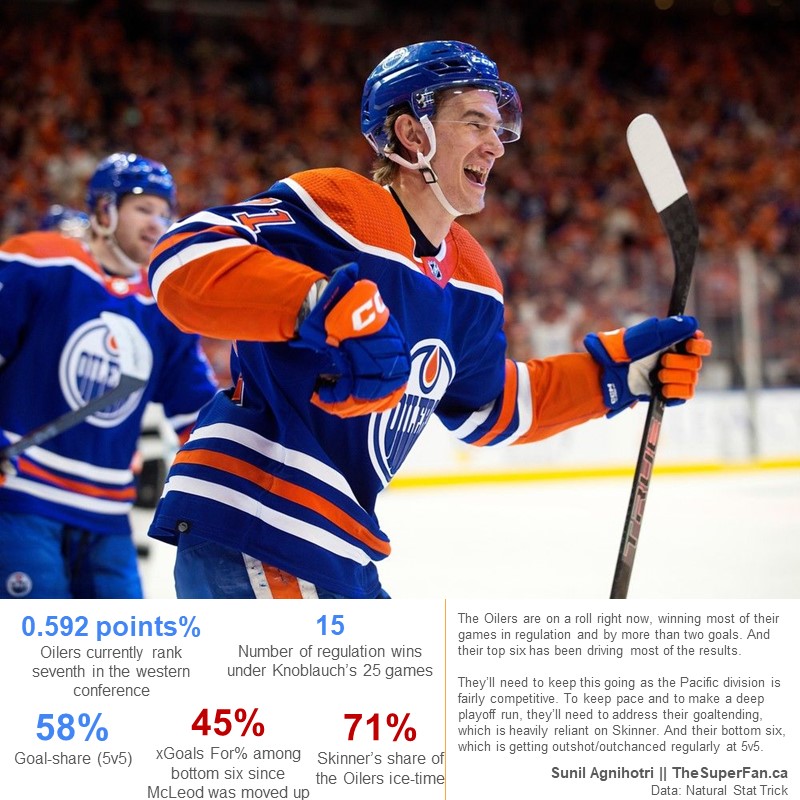
Pretty impressive turnaround for the Edmonton Oilers who are seventh in the western conference with a 0.592 points percentage, and fourth-best in the Pacific. They have the fifth best scoring rate in the league in all situations and sixth highest at even-strength (5v5). Their even-strength goal-share of 52.76% is eighth in the league and they’ll need to keep that going. Currently, six of the top ten teams in goal-share are in the western conference, four of which are in the Pacific division.
What’s especially impressive is the number of regulation wins the Oilers have posted since the coaching change. Since Kris Knoblauch took over behind the bench, the Oilers have won 19 games with 15 of them done without overtime or shootout. That’s the fifth highest number of regulation wins in the league since November 12th (when the coaching change happened). Worth noting that 12 of their wins (or 63%) have been by two goals or more – which is a better indicator of the team’s talent than one-goal games.
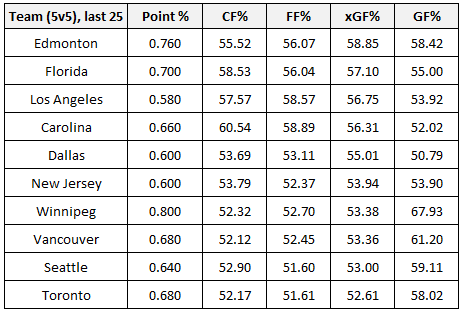
The Oilers even-strength (5v5) play has been solid, as they’ve outscored opponents 64-46 (58.18% goal-share, +18 goal differential) over the last 25 games since the coaching change. And their underlying numbers, like their 55.52 Corsi for percentage and 58.85 Expected goals-for percentage indicates that the 5v5 results are real and sustainable.
And while the Oilers are making the Pacific division standings interesting again, it’s worth noting that the rest of the teams in the Pacific are also posting some solid underlying numbers. In the last 25 games, the top ten teams in expected goals for percentage features four teams in the Pacific (table below is sorted by xGF%). The difference might come down to special teams, where some of the Pacific division teams are getting results on the powerplay or penalty kill. Covered that in my recent Pacific division check-in here.
It’s also worth keeping tabs on goaltending deployment across the division, which is going to have an impact on their playoff runs. While most teams are going towards a 1B/1A split between goalies, with most starters playing 59.90 percent of the team’s minutes this season, the Oilers are really riding their starter. Stuart Skinner has now played 70.60 percent of the Oilers total minutes this season, which is seventh highest in the league. That’s just behind Thatcher Demko, who has played 70.80 percent of Vancouver’s total minutes, and (interestingly) Cam Talbot who has played 72.90 percent of Los Angeles minutes. May recall Todd McLellan consistently starting Talbot in Edmonton in the 2016/17 regular season, where he played 86.70 percent of the total minutes. And how that impacted the Oilers playoff run that season.
Back to Edmonton’s current situation. If Calvin Pickard isn’t going to get regular deployment to give Skinner a rest and keep him fresh for the playoff race and (hopefully a playoff run), then management needs to address this and get someone the coaching staff actually trusts. Even since the coaching change (and Campbell’s demotion to Bakersfield), it’s been all Skinner who has played 73 percent of the team’s total ice time in the last 25 games.
The top six forward group, now featuring Ryan McLeod and Warren Foegele, is also crushing it right now since the Oilers made adjustments during their game against New Jersey on December 21st. Here’s how the top two line have performed over the last nine games at even-strength.
What’s a little concerning is how the bottom six have played the last nine games, with them not creating much and not allowing much either. In 139 minutes over the last nine games, the third and fourth lines have combined for 4 goals for, 4 goals against. And that’s largely because their Corsi For percentage is only 48% and their Expected Goals-for percentage is 45%. A whole lot of nothing going on there, which is concerning considering how big of a role team depth has on long playoff runs. Definitely an area to address by management, especially if McLeod is going to be on the second line.
One last thought on the new second line. It does re-affirm my belief that Draisaitl’s success largely depends on having a linemate that can also play center. McDavid is the obvious example, and so is Nugent-Hopkins who formed a line with Draisaitl and Yamamoto in the past. But I also recall a couple seasons ago when Draisaitl was on a line with Ryan Strome and Jujhar Khaira (both of which played center in their careers on depth lines) and had some decent success with them. In 108 minutes together between 2017-2019 (when Strome was an Oiler), they posted an on-ice goal-share of 56% (5 GF, 4 GA), and had a Corsi for percentage of 52% and an Expected goals-for percentage of 55%. So I’m not totally surprised that Draisiatl has found some chemistry with McLeod.
Since his tenth game of the season, McDavid went on to put up 24 even-strength points in the next 23 games. And he currently sits third in the league with 28 even-strength points – only behind Nathan MacKinnon (31 points) and Nikita Kucherov (29 points). McDavid’s current full-season rate of 3.21 points per hour is currently the highest among all top six forwards (226 players who have played at least 400 minutes this season).
The other factor in all of this has been McDavid’s ability to drive play generate chances again, and help tilt the ice in the Oilers’ favour. With him on the ice, the Oilers have historically seen an increase in their share of expected goals (which factors in shot type and location to determine the probability of shots becoming goals), which isn’t at all surprising considering his talent level. But that wasn’t the case early on in the season. After his first ten games, the Oilers were posting an expected goal-share of 52.22 percent with McDavid on the ice and actually saw an increase of 8.29 without him on the ice. That’s the opposite of what’s happened in the last three seasons where McDavid’s on-ice numbers were consistently well ahead of his teammates. Between 2020 and 2023, the Oilers posted an expected goal share of 58.34 percent with McDavid on the ice, which was 9.41 higher than what the team posted without him on the ice.
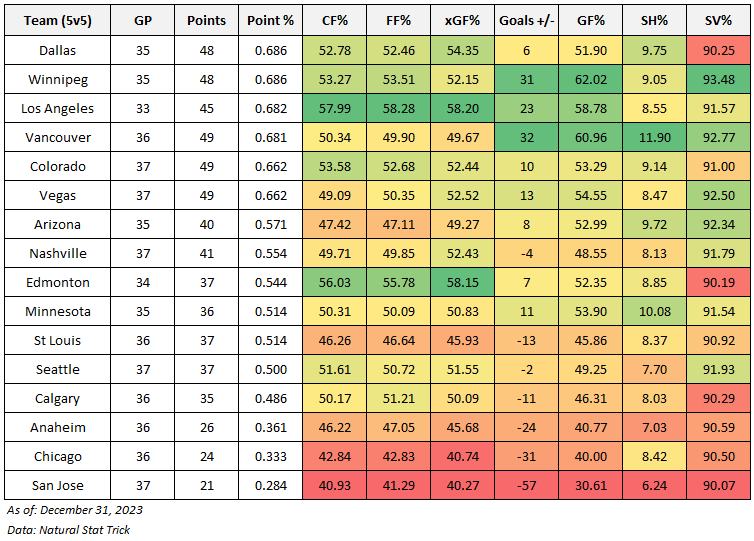
After 35 games into the regular season, the Edmonton Oilers are finally within striking distance of a wild-card spot in the western conference. A previous eight-game winning streak, and this current five-game winning game streak has pushed them to fourth in the Pacific division and ninth in the west (as of December 31st, 2023), having now accumulated 37 points and posting a 0.544 points percentage.
Below are the even-strength (5v5) numbers for each team in the western conference (sorted by points percentage), including goal-share results as well as the shot-share metrics that give us a sense of which teams have the right processes in place and if the results are sustainable or not. At the end of the table are each team’s shooting percentage and save percentage. I’ve also applied a basic heat map to each metric to show which teams are doing well or struggling relative to their conference foes (i.e., green is good, red is bad). You can also find a description of each metric at the end of this article. Please note that the shot-share metrics are score and venue-adjusted based on Natural Stat Trick’sTrick’s methodology.
As mentioned at the last check-in, there were plenty of reasons to believe the Oilers would eventually climb up the standings. The team’s even-strength (5v5) performance has been strong all season, with the club continuing to post some of the strongest shot-share percentages and expected goal shares in the league. And not a lot of of teams have pulled away in the standings. As long as the Oilers can continue getting average goaltending and depth scoring at even-strength, they should be able to secure a spot.
Below is a high-level snapshot of how each player’s on-ice numbers have been at even-strength (5v5) this season, split between forwards and defencemen and sorted by total ice-time. Included are the metrics I use to assess a player’s performance (i.e., shots and expected goals) as well as their actual on-ice results (i.e., goal differential). I’ve also included each player’s PDO, which assesses how lucky/unlucky they’ve been, and if we can expect their results to improve over the course of the season. A basic heat map has been applied to show how each player compares to the rest of their squad.
We know who the individual drivers have been this season and I’ve written enough about Kane’s season, so let’s focus on PDO and which players might see some improved results. Up front, I think Draisaitl’s and Foegele’s on-ice goal-differentials are bound to improve. They’re skating on a very effective second-line with McLeod, with the trio outscoring teams 9-2 in 48 minutes together. They might not be able to sustain this 82% goal-share, but their results should remain strong as they’re posting a 67% Corsi for percentage and expected goal share together. On the back-end, I think we’ll see Bouchard’s results improve as he continues to post strong on-ice shot-share numbers and skates with top-end players, but has one of the lowest PDO’s on the team.
Finally, here’s a quick look at how the western conference teams are doing on special teams, sorted by their points percentage. I’ve included the shots for and against to assess their performance and the goals for/against to assess the actual results.
Edmonton’s powerplay continues to be one of the best, no surprise. And their penalty kill results should gradually improve as they’re allowing one of the lowest rates of shots against. That’s a positive sign as the last thing they need in this playoff race is their special teams costing them wins as it’s done in the past. Looking at the teams Edmonton is competing with for playoff spots, Vegas and Colorado look like they have things figured out. As well as Nashville who should get better penalty kill results. I don’t see Arizona staying in the race as they’re even-strength performance numbers have been poor along with their penalty kill. And Minnesota is another team that could be sunk by their special teams.
Will be interesting to see how things play out over the next month with Edmonton playing a lot of the weaker teams in the league with no back-to-backs scheduled. If things go well, the Oilers could push for third in the Pacific. For now, it’ll be key to bank points and create some separation from the rest of the wild-card pack.
Points-percentage (Point%) – The total points accumulated divided by the points that were available, including extra time.
Corsi for percentage (CF%) – The proportion of all the shot attempts the team generated and allowed that the team generated (i.e., corsi for/(corsi for + corsi against). This is used as a proxy for possession and is the best at predicting a team’steam’s future share of goals (GF%). (Source: Hockey Great Tapes – Draglikepull)
Fenwick for percentage (FF%) – The proportion of all the unblocked shot attempts the team generated and allowed that the team generated (i.e., Fenwick for/(Fenwick for + aenwick against). This is used as a proxy for shot quality and considers shot blocking a repeatable skill.
Expected goals for percentage (xGF%) – This is a weighting placed on every unblocked shot based on the probability of the shot becoming a goal. This depends on the type of shot, location and uses historical shot and goals data to come up with the probability for each unblocked shot.
Goals for percentage (GF%) – The proportion of all the goals that the team scored and allowed that the team generated (i.e., Goals for/(Goals for + goals against).
Shooting percentage (SH%) – The percentage of the team’steam’s shots on goal that became goals (i.e., total goals divided by the total shots on goal).
Save percentage (SV%) – The percentage of the team’steam’s shots on goal against that were saved (i.e., 1-(totals goals allowed divided by the total shots on goal against)).







 The SuperFan