Developed by Mike Fail and Garret Hohl (Source)

I joined Lowetide on Monday morning to talk about the Oilers and how they should better integrate analytics. Full audio is here.
Couple notes:
A couple thoughts on analytics, and how best to integrate it into hockey operations.
With the Oilers cutting ties with analytics consultant Tyler Dellow, the club has an opportunity to re-set its current approach to analytics going forward. Now it was my hope that Tyler’s role would’ve expanded from a consultant position, perhaps into a director type, who would then lead a group of analysts to delve into various topics. It was my hope that the Oilers would’ve applied a more complete analytics strategy that could support and influence all aspects of hockey operations including on-ice tactics, player personnel decisions, drafting and salary cap matters.
And let’s not kid ourselves: analytics is going to have a role in professional sports, but its exact definition and scope is going to vary depending on the sport, league, team and goals. Analytics is becoming more and more ingrained in all industries whether it is healthcare, oil and gas, government, and the thought of the value of analytics fading in hockey is completely bogus.
Analytics should never be treated as some magic bullet or switch that an operations manager can just flip and make things happen. Analytics is a continuous process, one in which a business need or goal leads to questions. From there, an organization looks to its data to see what can be answered, and what other data can be collected and refined to potentially answer that question. From there, analysis of the data is done, which leads to discussion with the operations side and, quite often, leads to more data collection/analysis/discussion.
Before all of this is even thought about, teams like the Oilers have to treat analytics as a new concept that has to be assessed carefully before it’s legitimately integrated. And like most organizations, the Oilers need to look at three areas: people, process, technology (or tools).
People:
Processes:
Technology/tools:
One thing that I hope the Oilers consider doing is finding a way to tap into the knowledge of the fan community, especially those that spend hours analyzing data and publishing their work online. And this really isn’t a long shot for the team. Keep in mind, the Oilers have put together a volunteer advisory group in the past to support hockey operations and they’ve also hosted a Hackathon competition where they posted a question, released a pile of data and rewarded the best solution (nice work Parkatti!). What I think the Oilers can do here is enhance these two concepts and turn them into actual, formalized programs that can be sustained and provide value to the club.
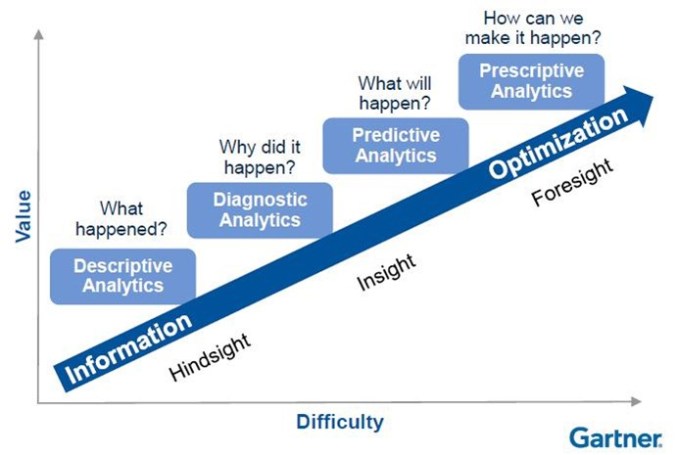
One thing I have trouble wrapping my head around is when NHL teams hire a consultant or two to support their analytics process. Above is a chart from Gartner, which does a really nice job breaking out analytics into four types: Descriptive (what happened?), Diagnostic (why did it happen?), Predictive (what will happen?) and Prescriptive (how can we make it happen?). What we see without even caring about value and difficulty of each type are complex tasks that each require more than just a data analyst or consultant.
Looking at this through a hockey lens, the first type would be simple reporting, as in how many goals happened for and against. With Diagnostic, you would start looking into shot shares/location/player deployment/line match-ups, etc, basically looking at the things that you think do a good job at predicting goals. These first two types of analytics have become pretty standard things in the hockey world, and are published daily by fans online. But if you’re running a team, your hockey operations department could be looking at more than just goals for instance and the things that lead to goals. Maybe you want AHL player data, or a better way to track the passes that lead to shots. And if that’s the case, you need a way to gather and refine that data, which could require manual tracking and someone with programming experience. If your club wants the findings shared in a certain way, you may need someone who specializes in reporting or even dashboard reporting. And it’s also here that you may need someone who can break down video and compile their findings quickly for the coaches or management to use.
And when you start getting into the prescriptive analytics, you’ll absolutely need someone on the analytics team that has coaching experience or someone that can marry the data to the actual on-ice plays to make sense of it and provide recommendations. Reviewing these types of analytics and the potential value it can bring to a team, it would be imperative that a team like the Oilers put together a complete analytics team. This should include a director type, along with analysts well versed in reporting (dashboards), programming and on-ice coaching. Teams like Toronto, Florida and New Jersey have this structure, which should become the norm among NHL clubs soon.
It’ll be interesting to see what the Oilers do in regards to their approach to analytics. In my experience, analytics is one of the many tools that business leaders rely on to make informed decisions and is part of a holistic approach to finding success. The purpose of analytics, especially in a business setting, is to provide evidence, drive discussion and support the corporate goals. And it can only be leveraged to its full capacity when there’s complete support, at the strategic level and the operations level.
Curious to hear the thoughts of others on this one. Every industry is different, so I’d be interested in hearing how others have implemented/experienced analytics.
Also joined Lowetide on TSN 1260 to talk about this further. Audio is here.
This past week, Ryan Stimson of Hockey Graphs published a very insightful article where he attempted to quantify two offensive zone strategies that teams rely on, focusing on the tactics used by the San Jose Sharks and Los Angeles Kings this past season. This was following some comments made by Kings assistant coach Davis Payne, who presented at a coaching clinic in Buffalo. The full article is a must-read for anyone interested in team systems and analytics.
Two tactics, the Low-to-High-to-Net Attack, where assists come from point shots, and the Behind-the-Net attack, where a play is developed from behind the goal line, are explained extremely well in the above article, including plenty of video to explain the tactics and the pros and cons for both plays.
Since the passing data is publicly available, I figured it would be worth digging into the Oilers numbers and verifying what we’ve heard the coaching staff discuss this past season, including McLellan’s concept of volume shooting.
Full article is at The Copper & Blue.
Joined Lowetide this morning on TSN 1260 to talk Oilers. Full clip is below, starting around the 40 minute mark.
Couple notes:
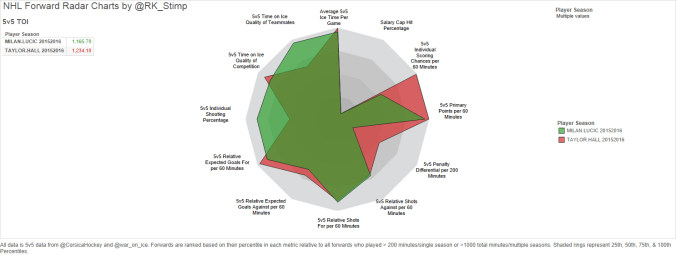
This one is from Ryan Stimson of Hockey Graphs:
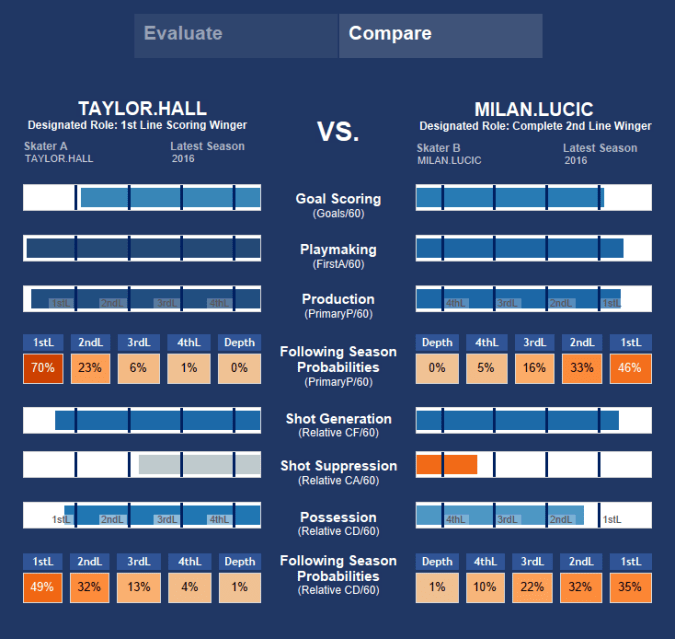
And this one is from Own the Puck:
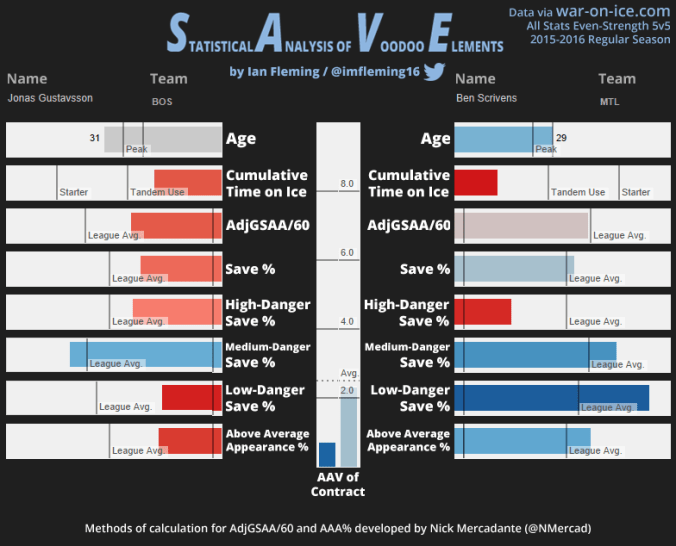
Heading into the summer, it was fairly obvious that the team would need to find a dependable backup to play behind Cam Talbot and push young Laurent Brossoit down to Bakersfield for additional seasoning. Although Brossoit had put up some nice numbers at the AHL level, his showings in Edmonton were not very good, as the young prospect appeared in five games, finishing 0-4-0 with a sub-standard 87.18 save percentage at even-strength (Source: Corsica Hockey)
On July 1st, the Oilers did find a backup in 31-year old Jonas Gustavsson, who played with the Bruins last season going 11-9-1, with a 91.42 save percentage at even-strength. Among the 55 goalies who played at least 900 minutes last season, or around 20 games, similar to Gustavsson, the Oilers newest addition ranked 47th when it came to save percentage at even strength, the average of the group being 92.46. The season prior, Gustavsson only played in seven games, with Jimmy Howard and Petr Mrazek taking on the bulk of games, and did show well, but it’s hard to make any large conclusions based on such a small sample size.
Full article is at The Copper & Blue.
Something to consider now is how defenceman Adam Larsson will fit into the Oilers in terms of pairings, deployment and match-ups. Judging by some of his underlying numbers, Larsson has performed as more of a shutdown type defencemen in New Jersey that starts a lot of shifts in his own zone, typically against the best competition.
To put Larsson’s deployment in New Jersey into perspective, I’ve generated a player usage chart from Corsica Hockey to show how he measured up against his teammates last season at even-strength. The x-axis is the Zone Start Ratio (ZSR), which is the percentage of non-neutral zone starts that are offensive zone starts. The y-axis is the Time On Ice Quality of Teammates metric (TOI.QoT), which is the weighted average time-on-ice percentage of a player’s teammates. The bubble size is the individual player’s Time On Ice Percentage, which is the percentage of a team’s time-on-ice played by a player. And the coloring of the bubbles is the individual player’s Corsi relative to his teammates. (Source: Corsica Hockey).
/cdn0.vox-cdn.com/uploads/chorus_asset/file/6754383/UsageChart_-_NJ-20152016.0.jpg)
Full article is at The Copper & Blue.
Joined Alan and Phil from Arctic Ice Hockey to talk Oilers this past weekend. Full podcast can be found here (starting around the 8:00 minute mark after the intro):
http://www.cyberears.com/index.php/Browse/playaudio/29784
Topics included:
Thanks again to Alan and Phil for having me on.
Joined Lowetide on Monday morning on TSN 1260 to talk about the Oilers, the Hall-for-Larsson trade, what to expect from Milan Lucic, center depth and potential moves on defence. Full audio is here (starts around the 25 minute mark):
Related links:
Should the Oilers consider adding Milan Lucic this summer? – The Copper & Blue
Looking into Milan Lucic … Again – The Copper & Blue
Thoughts on the Hall Trade – The SuperFan
 Trading a star player is never easy, especially when the return fails to meet expectations. Adam Larsson is a good player, someone who can play in your top four, and be reliable in his own zone. He fills a need on the right side, and gives the team more options when it comes to line matching and deployment. But the fact is, the Oilers lost an elite winger, someone who has put up very impressive numbers, despite never having a legitimate defence core behind him.
One thing I do wonder is if Hall’s decline in powerplay productivity had any influence on the team trading him away. One metric that I look to to determine a player’s value on the powerplay is Fenwick For/60 (the rate at which the team generate shots that are unblocked with the man advantage – check out Objective NHL for more ). Hall typically leads the team in FF/60 RelTM by a far margin every year, but this past season, for whatever reason, his numbers took a hit (Source: Hockey Analysis)

I only came across this a few months ago when I was digging into the team’s powerplay struggles. My guess is that because there are so many left handed shots, and, as pointed out in the comments section, Hall and Draisaitl set up around the same area of the ice. I’m not 100% sure what was going on, but I’m hoping this isn’t one of the reasons Hall got dealt.
As for Larsson, the Oilers are getting a defensive defenceman, who I think has been limited offensively because of the Devils style of play. A good review of the trade, including a profile of Hall and Larsson can be found over at All About the Jersey. An excerpt:
According to Corsica, Greene and Larsson had the highest time on ice quality of competition, or the weighted average of the time on ice percentage of their opponents. They also started in their own end of the rink around 44% of the time, also the most among Devils defensemen at 5-on-5. Who led the penalty kill on defense? You guessed it, Greene-Larsson. They both got wrecked from a possession standpoint, also according to Corsica. From this past season. Larsson’s CF% (44.59%) and relative CF% (-2.45%) does not look good at all. However, those figures should not have surprised anyone since the Devils only bested Colorado in CF% last season. #5 (and #6) had to play a lot of defense in 2015-16 and did their best from getting entirely overwhelmed. To me, it is more of the fault of the team and its systems as opposed to Larsson or Greene being porous. If nothing else, Larsson showed he could handle it for twenty-two and a half minutes per game, per NHL.com. For less than $4.2 million per year on the salary cap, I think Larsson provided good value.
We can also get a quick snapshot ofusing the HERO charts.

Here we see again an offensively challenged defenceman, but someone who plays the tougher minutes (more defensive zone starts against the oppositions top lines) and actually comes out okay. The team does better when it comes to xGF% (a measure of shot quality) with Larsson on the bench, but that might be because of how he’s deployed.
David Johnson from HockeyAnalysis.com also did a deep dive into Larsson’s numbers and came away with this:
To conclude, I believe the Oilers may have picked up a real good defensive defenseman, maybe one the leagues best (still a bit early to say that yet). I look at a guy like Hjalmarsson in Chicago. He doesn’t get all the accolades of Toews, Kane, Keith or even Seabrook but he is an incredibly valuable players on that team an done of the best defensive defensemen in the league. If the Oilers get this in Larsson they will be filling a much needed and an incredibly important role. Is that worth Taylor Hall? Almost certainly not but Larsson could be an incredibly important player for them for the next decade and guys like him don’t grow on trees either.
I’m of the sense that the Oilers defence improved today, but it was for a very high cost. I understand the current situation of the team and the lack of right shot options out there. It just should not cost you an elite winger like Hall. What is most frustrating is how the Oilers got themselves in this situation. A complete disregard for player development, especially defencemen, started in 2006 with Pronger’s departure and continued on for a decade. The club operated at one point without a proper farm team before finally realizing that their prospects need a place to develop and mature into proper NHL players. It was under Tambellini that the Oilers committed themselves to the idea of a development system and actually churned out some good players through Oklahoma City. And when these players were ready (i.e., Petry, Marincin), the club traded them away, for reasons I still don’t completely understand.
What should be alarming is the fact that the same mindset and strategy that got us in this mess of trading Hall is still lingering in the organization. We saw last year how the club had to dress Nurse and watch him struggle on a regular basis. We saw Reinhart get developed at the NHL level last season rather than spend a full season, or two, in Bakersfield before moving up. Really, the Oilers should have enough NHL calibre defencemen in the lineup so that the prospects can develop at the right levels. If the team does not change their approach to defenceman development and deployment, we’ll for sure be trading away another highly touted player in a few years to fill a hole.
One last thing that’s been on my mind with Hall being traded away is that 2009/10 season that got us Hall in the first place. It was the year that the Oilers truly tanked to ensure that they got the top pick. It was a season where the team genuinely did not care about winning and did everything it possibly could to sewer the season. Fans had to sit through Ryan Potulny and Sam Gagner as centers. Jeff Deslauriers dressed in 48 games. And the defence was barely AHL calibre with Souray being cast away. The club finished 27-47-8, good for a 0.378 points percentage). Source: Hockey Reference.
Bigger than the actual Hall trade is how we got to this point and what the many warning signs were that something like this would happen. The poor drafting record outside of the first round (Mitch Moroz, David Musil), the poor player development (Sam Gagner, every defencemen drafted), the poor personnel and contract management (Jeff Petry, Sheldon Souray)…these are all the things that have lead to Hall’s departure. Without recognizing these cases from the past 10 years and changing their approach on how they operate, the Oilers are bound to repeat these mistakes and soon.
 The SuperFan