Evaluating a depreciating asset: Checking in on Adam Henrique’s season

Back in early September of 2025, I had identified Oilers veteran forward Adam Henrique as someone who could potentially see their ice time decrease to make room for some of the younger players.

This was because Henrique:

  • had been seeing his point production decline;
  • been negatively impacting his team’s ability to control shots and scoring chances at even-strength;
  • hadn’t had a positive impact on the special teams, specifically the penalty kill, and
  • was in the last year of his contract.

You can read the full article here: Depreciating assets (2025, September 13)

With the news that Henrique is being place on injured reserve and unavailable until after the Olympic break in late February, I wanted to see if his decline has continued this season based on the three areas I had originally focused on. And if the Oilers are better or worse without him in the lineup. He’s been a regular for the team this season, unlike some other veterans who have seen time in the press box despite having multi-season contracts.

Productivity at even-strength (five-on-five)

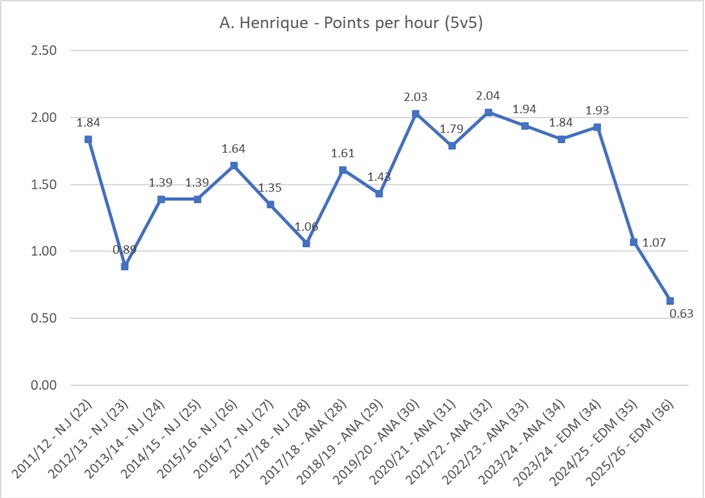
This season, Henrique has only one goal and four assists at even-strength (5v5) in a predominantly bottom-six role. That translates to only 0.63 points per hour, which is part of a continued decline for the 36 year old.
.

Henrique currently ranks 16th out of 17 Oiler forwards who have played at least 50 minutes, only ahead of Trent Frederic. This is beyond replacement-level production now.

Negative impact on the team’s even-strength performance

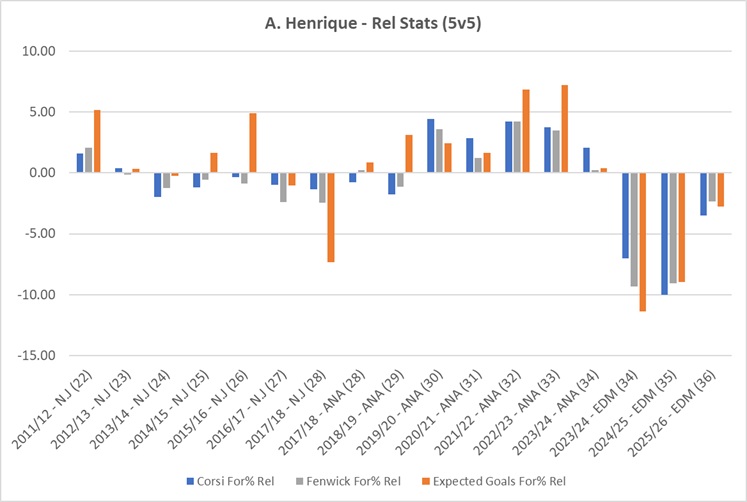
We saw over the last few seasons the negative impact Henrique would have on his team’s ability to control the flow of play and scoring chances. With him on the ice, the Oilers would spend more time without the puck and chasing the game, and almost every player on the team saw their on-ice numbers take a hit when Henrique was deployed with them.
.

This season Henrique has continued to have a negative impact on the team’s offensive opportunities, but it hasn’t been as bad as previous seasons. That’s progress, I guess. But it’s part of a continued downward trend, and hard to ignore. The entire bottom six group has been a dumpster this season at evens, and Henrique has been a major part of that.

  • [Update] Worth noting that part of Henrique’s slide is the amount of time he’s played with Trent Frederic who is having a terrible season. Together, they’ve posted on-ice shot-share numbers below 44%, and when Frederic is away from Henrique, it’s not much better. But when Henrique is on the ice away from Frederic, his on-ice shot-share numbers are at or above 50 percent. Thanks to @gofortwoelks on BlueSky for the heads up!

Not so special on special teams

Okay, so here’s where things are a little interesting. The last few seasons, Henrique has not been great on the penalty kill with the team allowing a higher rate of shots against with him on the ice. This year, however, the Oilers actually see a drop in the rate of shots and chances against with Henrique deployed, which could explain why he’s leading the forward group in ice time on the penalty. And why he has a regular spot in the line up.

For context, the Oilers penalty kill ranks 17th in the league, allowing 7.52 goals against per hour. Main reason for the mediocre results: they allow the 11th highest rate of shots against per hour (56.21) and the eighth highest rate of unblocked shot attempts per hour (a proxy for scoring chances) with 85.07. The team’s goaltending has actually been decent, ranking 10th in the league with a 86.63 percent save percentage.

With Henrique on the ice for the penalty kill, the team allows a rate of 42.71 shots against per hour. Without him, this rate jumps by over 30 percent to 63.77 shots against per hour. That’s a significant difference, which should raise some concern for the team as they’ll need their penalty kill results to be strong – especially with the team struggling to outscore teams at even-strength. Right now, the Oilers have allowed 6.70 goals against per hour with Henrique out there, which is lower than the team rate, and significant lower than what Nugent-Hopkins is posting (12.08 goals against per hour, driven largely by a rate of 73.69 (!) shots against per hour). If RNH is taking on more penalty kill minutes, expect the results to get much worse.

So while the Oilers should be able to handle Henrique’s absence at even-strength, and will likely be better off without him in the lineup, the penalty kill performance and results are likely going to get worse.

Data: Natural Stat Trick
Debunk the funk

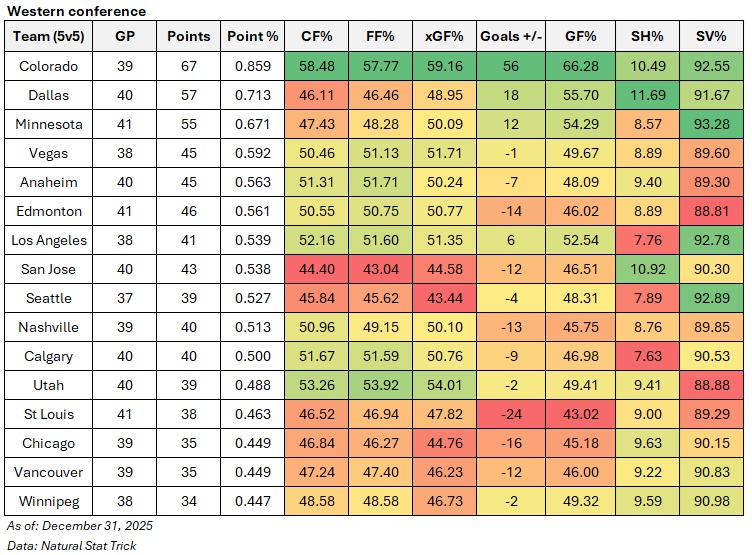
While things look great for the Edmonton Oilers – currently sitting first in the Pacific division with 46 points in 41 games – it’s not likely to last very long. Their actual points percentage is 0.561, which is third behind Vegas and Anaheim in the Pacific, sixth in the west and sixteenth in the league. Their actual goal-share in all-situations is +1, but that’s largely driven by their success on the powerplay. At even-strength, their goal-differential is -13, a goal-share of only 46 percent that ranks 26th in the league. And all of their underlying shot-share metrics at even-strength are barely at the break-even mark.

The Oilers are nowhere near where they were last season at this time. And it’s not what you’d expect from a team with championship aspirations.

The good news is that the rest of the Pacific division is a bit a joke right now. Vegas currently has the best goal differential with 0 (yes zero, not a typo). And only Los Angeles has a goal-share above 50 percent at even-strength. Edmonton has shown signs of progress in December, but they still lack that consistent play and production that’s expected from a high-end team.

Western conference context

Below are the even-strength (5v5) numbers for each team in the western conference (sorted by points percentage). These include goal-share results and shot-share metrics, which give us a sense of which teams have strong underlying processes — and which are over- or underperforming. At the end of the table, you’ll find each team’s shooting and save percentages. A simple heat map highlights which clubs are excelling (green) or struggling (red). Note: all shot-share metrics are score- and venue-adjusted per Natural Stat Trick’s methodology.

The Oilers have definitely made some progress since my last check-in at the end of November when they were 11th in the west with a 0.519 points percentage, even surpassing the cluster of teams that I had predicted. I’d have a lot more confidence in them if they can string together a set of ten games or so where their shot-share numbers are above 53 percent and their goaltending improves. They can’t string more than two wins together, which could open the door for another team to eventually pass them.

Again, the only real dominant team in the west is Colorado, with Dallas and Minnesota riding some excellent goaltending to stick around in that contender cluster. Vegas and Anaheim should be able to stick around just based on their underlying shot-share numbers, but they also appear to have some goaltending issues. Los Angeles is in that group as well, and have the goaltending which could propel them higher. And it’ll be interesting to see if Nashville, Calgary or Utah can leap frog some of the pretenders to lock up that eighth spot.

Evaluating individual players

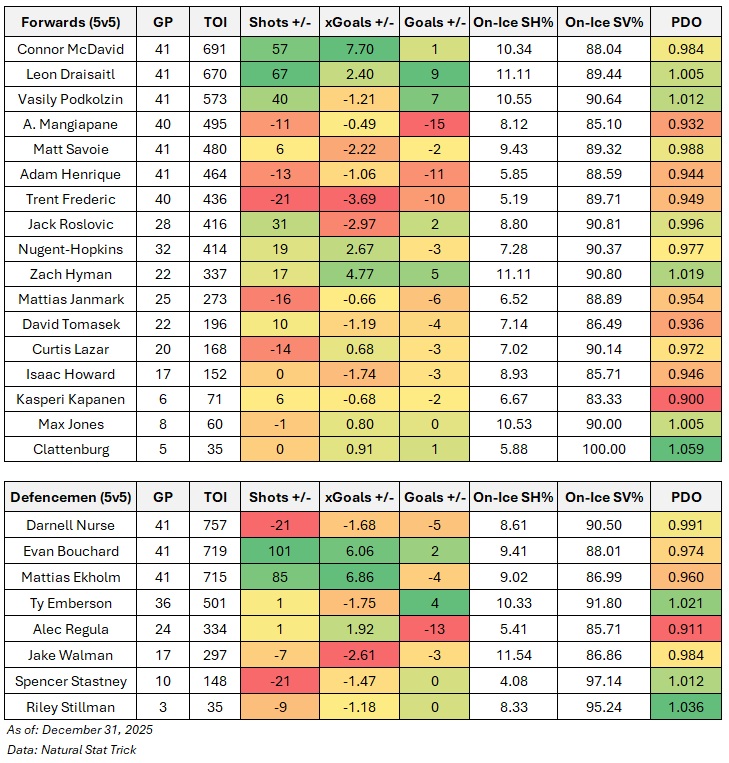
Here’s a quick look at the Oilers’ skaters, and their on-ice numbers so far sorted by ice time. Included is each player’s on-ice shot differential, expected goal differential and actual goal-differential. And for additional context, each player’s on-ice PDO is captured. A basic heat map is applied to show how players compare within their cohort.

Not a whole lot to note since the last check-in. Mangiapane’s been healthy scratched, which isn’t surprising since his performance and results have been poor. And as mentioned last time, Savoie was likely to continue sliding just based on his on-ice numbers. He’s even seeing his minutes cut back, which I don’t think is a bad idea. He could use a little reset and the coaching staff could test out some wingers on that second line with Draisaitl and Podkolzin.

The bottom six is a dump at this point. In an ironic 911 minutes without McDavid or Draisaitl on the ice at even-strength this season, the Oilers have been outscored 19-43 – a pathetic goal-share of only 30.7 percent (-24 goal differential). Remember- these depth players get 45 percent of the team’s total ice time and this is the best that they can muster. And it’s hard to believe things are going to turn around any time soon. Their shot-share numbers without one or both of the Glimmer Twins deployed only hovers around 45 percent. Now might be a good time to promote some of the kids in the AHL to see what they have and if they can help turn things around.

Nothing really noteworthy on the back-end. Nurse is still a problem that needs to be managed. And the team desperately needs Walman back to help stabilize things. I do suspect that the bottom six is struggling because of the instability on the back-end, but would need to dig in further.

Data: Natural Stat Trick