CBC Radio Active: Fans back at Rogers Place

I joined Rod Kurtz on CBC Radio Active to talk about the Oilers and their free agency activities. Full segment is here: CBC Radio Active (2021, September 28).

Topics we covered:

  • Oilers first home pre-season game and the first one with fans in the building since March 11, 2020.
  • Management’s off-season approach of adding veterans to the roster, where the strengths are in the roster and the weaknesses.
  • Key prospects on the team and where they could fit this upcoming season.
  • Goaltending and why the team needs to be looking for help.
  • What to watch for this season (even-strength scoring without McDavid on the ice, line combinations, prospects and the penalty kill)

Thanks to the team at CBC for putting it all together!

Moving on from Archibald

With training camp underway, the focus should be on the potential line combinations and defence pairings for the upcoming season, which young prospects will emerge and take on important roles – and really just getting as much information as possible about this roster. And we’re getting plenty of content and storylines to follow and dissect, already within the first couple of days. But it’s pretty hard to ignore the situation with forward Josh Archibald and his reluctance to get vaccinated to spend training camp with his teammates.

Now, Archibald has had plenty of time to get things sorted out and has probably had more than a few discussions with management and the coaching staff to talk about the impacts of his decision to his career and to the team. If he hasn’t straightened things out at this point with training camp already underway, why are the Oilers so hesitant about assigning him to the AHL or even terminating his contract? He’s on the second year of a two-year contract that pays him $1.5 million this upcoming season and is very, very replaceable.

This is clearly a fourth line player averaging about 10-11 minutes per game at even-strength (5v5) and producing 1.18 points per hour over his 235-game career. He’s not a shut-down player, spending the majority of his ice-time against lesser competition. And has in fact been a part of the depth problems the Oilers have been experiencing, specifically when McDavid has been on the bench. In his two seasons with the Oilers, the team has posted a goal differential of -23 (38 GF/61 GA) with Archibald on the ice, a goal-share of 38.4%. Part of the reason for that is the team has poor possession numbers with Archibald on the ice, with the team posting a Corsi For% of 45.5%. And again, this is predominantly against the opponents third and fourth lines and away from elite competition.

Where the coaching staff does have faith in Archibald is on the penalty kill, as he lead the Oilers forwards in total shorthanded ice-time and average ice-time per game in 2020/21 and had the second most minutes the year before. And while the results have been good for the team in terms of preventing goals, with the team allowing about the same rate of goals against with and without Archibald on the ice in the last two seasons, they do a see a significantly higher rate of shots with Archibald deployed. Without him, the Oilers have allowed about 51 shots against per hour, which is just slightly better than league average. With him, that rate of shots against jumps up to 64 per hour, an increase of about 25%. Now part of that has to do with the fact that he’s often played against the other team’s top power play units. But keep in mind, top penalty kill units see an increase of +5.45 shots against per hour relative to the team rate. Archibald’s rate of shots against (+12.27) is double the league average of top penalty kill units, so you really can’t put it all on the level of competition.

Knowing the Oilers might be starting the season without Archibald, the Oilers did bring in 32-year old Colton Sceviour on a professional try-out agreement, who appears to be a pretty seamless replacement for Archibald. He’s played 500 NHL games, has played a similar depth role as Archibald averaging about 10 minutes a game at even-strength and has a slightly better career points-per-hour rate of 1.41.

Sceviour also has plenty of experience on the penalty kill, becoming a regular option during his four seasons in Florida between 2016 and 2020 leading the team in ice time and average ice time per game.

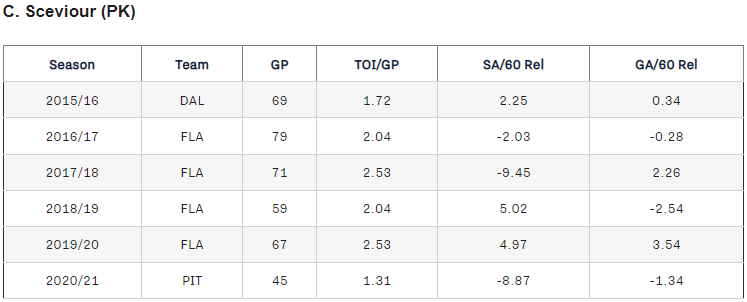
Sceviour posted some pretty solid on-ice penalty kill numbers in Florida for a player who was deployed as often he was. In two of his four seasons, the rate of shots against were lower relative to his team numbers. And a couple times the rate of shots against were higher but reasonably in line with what happens across the league when top penalty killers are on the ice. Sceviour did see his average ice time drop as a new member of the Penguins last season. But the club did quite well at suppressing shots with him on the ice, seeing their rate of shots against drop by 8.87 shots per hour.

With a replacement like Sceviour who can play depth minutes and has experience killing penalties already participating in the Oilers training camp, the Oilers really should move on from Archibald as soon as possible. The club needs to sort out their even-strength line combinations, give players time to develop chemistry and figure out their special teams – especially their penalty kill, which is going to look a lot different than last season.

More importantly, the Oilers need to make a clear statement that the organization understands the gravity of the global pandemic and do not want to risk the health and safety of their staff, their players, the fans and the community. Letting the decision to move on from Archibald linger is a terrible look for Oilers management, the coaching staff and the leadership group among the players, especially since it’s been revealed that one of their own teammates is still dealing with complications from being diagnosed with Covid-19 last year.

This really isn’t a hard decision or a tough stance to take. Organizations around the globe are making vaccines mandatory to protect their businesses and their industry, and the Oilers really have no excuse here trying to accommodate a single player who doesn’t seem to care about the consequences of his actions. It’s a big season coming up with high expectations for the club – and the focus at this point should be on the players who want to be at training camp and want to have a strong season.

Data: Natural Stat TrickPuck IQCap Friendly

Penalty kill options up front

Something to watch for this upcoming season is how the Oilers coaching staff assembles the penalty killing units. As I wrote a couple weeks back, the Oilers lost some key defensemen with Larsson and Bear now skating with other teams and are taking a risk if they’re expecting Keith and Ceci to take on those minutes and have success.

Things are just as interesting up front. Last season, nine forwards played at least ten minutes short-handed for the Oilers, with Archibald, Nugent-Hopkins, Khaira and Haas leading the team in total ice-time and average ice-time per game. Two of those four are playing elsewhere this coming season with Khaira signing with Chicago and Haas signing with EHC Biel Bienne in the Swiss league. And there’s a chance now that Archibald with miss significant time as an unvaccinated player. Considering how high the rate of shots and chances were when the Oilers deployed other depth forwards like Shore or Turris last season, it’s really looking like the new additions to the team, and perhaps even an emerging prospect, will take on a greater share of the penalty killing minutes.

For reference, the table below sorts the penalty killing forwards from the 2020/21 season by total ice time (TOI), and includes the percentage of the team’s total penalty kill ice time the player was on the ice for (TOI%) and time on ice per game played (TOI/GP). I’ve also included each player’s on-ice rate of unblocked shot attempts against (FA/60), shots on goals against (SA/60) and goals against (GA/60). I’ve also included the table for the 2019/20 season.

What stands out when looking at the data is how much Tippett has relied on Archibald, deploying him for 43% of the team’s total penalty killing time in the 2020/21 season, which was only a slight increase from the 2019/20 season when Archibald finished with the second highest ice time (39% of the team’s total time) and average ice time among forwards, only behind Sheahan. It’s worth noting however that the Oilers allowed a significantly higher rate of shot attempts and shots against with Archibald on the ice, with a higher than normal on-ice save percentage keeping his rate of goals against within a reasonable range.  

Khaira’s numbers stand out as well. He gradually took on more and more responsibility seeing his average ice time per game grow from 1:30 in 2019/20 to just under two minutes in 2020/21. His on-ice results were solid as well, with the team allowing a lower rate of goals against with him on the ice than without him.

Haas was a nice addition to the Oilers penalty kill last season after Turris failed to secure the role. Likely because of his ability to shut down offence at even-strength, really at both ends of the rink, Haas was given a bigger role in 2020/21 and came through for the coaching staff. With Haas on the ice last season killing penalties, the Oilers posted the second lowest rate of shot attempts against, shots against as well as the lowest rate of goals against.

With Nugent-Hopkins likely staying on as a penalty-killer, who else could Tippett use to fill the vacant roles? Before looking at the options, a re-cap of what we know about Tippett and his coaching staff from their two years with the Oilers:

  • They typically use bottom six forwards on the penalty kill, with Nugent-Hopkins being the exception. Yamamoto did get some ice-time, as did Draisaitl, but they prefer to keep top-six players fresh for even-strength play and the powerplay.
  • Tippett likes having a right-handed forward option who can handle faceoffs as opposing powerplays often elect to have faceoffs on their left side. It was part of the reason why Turris was given the first opportunity to secure a role on the penalty kill.
  • The Oilers prefer veteran players who have a history on the penalty kill. Guys like Sheahan and Granlund were regular options averaging over two minutes per game with their previous teams before arriving in Edmonton and got the first opportunity to secure a regular spot in the rotation. The only youngster to get an opportunity on the penalty kill in the last two seasons is Ryan McLeod who played just under 11 minutes total in 2020/21.

Based on that criteria, here’s the list of options I have in mind that could be regular penalty killers in 2020/21:

  • Derek Ryan
  • Warren Foegele
  • Zach Hyman
  • Colton Sceviour

I know the coaching staff is going to look at Shore as an option. But the team allowed some of the highest rates of shot attempts and shots on goal against when he was on the ice last season. Plus, he’s never averaged more than 1:30 per game in a season, often ranking fifth or sixth in ice time on his previous teams. Turris cannot be an option at this point either, even though the team will do everything they can to squeeze some value out of him. He had poor on-ice numbers on the penalty kill before coming to Edmonton, and there really is nothing in his game or his history that indicates he can ever do well shorthanded. McLeod should also get some reps considering he’s a depth centerman and did have some nice numbers in his limited minutes last season – posting a very low rate of on-ice shots against and zero goals against in just under 11 minutes of ice-time. But that’ll depend on how much patience the coaching staff has for the young rookie and if they’re willing to develop him in a season when there’s a lot of pressure to win.

On to the options.

Derek Ryan is pretty close to meeting the coaching staff’s penalty kill criteria that I listed above. He’ll be a bottom six player for the Oilers next season. He’s right-handed and has a lot of success taking faceoffs. And while he hasn’t been averaging over two minutes of PK time per game, he’s typically been third or fourth in terms of total ice time and average ice time per game in his three seasons with Calgary. Considering his even-strength shot-suppression numbers are similar to Haas, I suspect he’ll take on similar minutes and hopefully have similar results on the penalty kill.

Warren Foegele is another option if he finds himself playing on the third line, potentially with Ryan. He was not a regular penalty killer during his three seasons in Carolina, averaging about a minute per game and ranking fifth or sixth in terms of ice time among forwards and taking the rare draw. The Hurricanes did see a drop in their rate of shot attempts against when he was on the ice, so there’s some potential there.

Zach Hyman could get a look on the penalty kill considering he averaged over two minutes per game in his last five seasons with the Leafs, took draws and had some good seasons in terms of on-ice rates of shots and goals against. Although he’ll likely be a top six forward at even-strength, there may not be space for him on the powerplay, freeing him up for the penalty kill.

Colton Sceviour is the one player that meets all three criteria and is probably the best option to replace Archibald’s minutes. He’s played over 500 NHL games. He’s right-handed and has experience taking faceoffs. And in his four seasons with Florida between 2016 and 2020, he lead his team in ice time on the penalty kill averaging over two minutes per game. And while he did see his average ice time per game drop last season in Pittsburgh, the club allowed a lower rate of shots and goals with him on the ice, similar to some of his seasons with Florida when he was on the first penalty killing unit. His career on-ice numbers are stronger than Archibald’s (refer to the Appendix), making him an ideal candidate for that first unit. This is all dependent of course on him showing well in training camp, finding some chemistry with a potential linemate and signing an NHL contract.

A lot of pressure on this team heading into the season, and I can’t imagine the coaching staff is too comfortable with so much change happening on the penalty kill. But while they’re losing key players up front, there appears to be some good options if the coaching staff is willing to try it out. The concern here is that they go with the players they know and have signed and give ice-time to Shore or Turris instead of someone like Sceviour who starts training camp on a PTO. We’ll see how things play out.

Data: Natural Stat Trick

Appendix: On-ice penalty killing numbers

Consumer confidence

Oilers GM hopeful NHL season can be saved | CTV News

One of my favorite articles this summer was Dom Luszczyszyn’s look at how much confidence the public has in the front offices of every NHL club, and how poorly the Oilers ranked compared to the other 31 teams.

The results were based on a survey The Athletic conducted asking subscribers to evaluate teams based on six main categories: roster building, cap management, drafting and developing, trading, free agency and vision. Highly recommend checking Dom’s article out; major kudos to him for continuing to do this annually.

I can’t say I was too surprised with how poorly the Oilers ranked, considering how many blunders they’ve made over the last few years – and this off-season was a continuation of Holland’s approach. When completing the survey myself, I ranked the Oilers front office quite poorly for all six categories, and have noted my thoughts on each below.

Roster building: How the front office has managed its roster, looking in general terms about the players in the system and whether they formulate the right building blocks for the team’s goal of contending, whether that’s in the present or future.

This was pretty straight-forward for me. With a superstar like McDavid under contract, management should be evaluated entirely on how the team does without him on the ice. And so far in the two seasons with Holland in charge, the Oilers have failed to assemble a roster that can break-even in terms of goals and shot-share metrics when McDavid is on the bench at even-strength. In fact, this past season the Oilers posted some of their worst underlying numbers since McDavid’s arrival, thanks in large part to the depth players Holland signed to contracts.

With McDavid on the roster, the goal has been and always will be a championship. And it’s hard to feel confident in Holland’s ability to get roster-building right when the players him and his staff have signed are a big reason why the Oilers can’t post a positive goal-share at even-strength.

Cap management: How the front office has managed the team’s finances, with regards to the efficiency of money spent (are there a lot of bad contracts on the books), cap space, future flexibility and general dollar worth. Bottom line: If a team is or isn’t spending money, are they doing so wisely?

If there’s one thing we’ve confirmed about Ken Holland it’s that he does not integrate analytics into his overall decision-making process. One of the key benefits of analytics is being able to cut through the noise that personal and group bias brings to your organization. It makes you question what you’re seeing, what you’re hearing and forces you to think and re-think a problem. It’s challenging and uncomfortable and requires a lot of effort individually and collectively. But having a process in place that draws in and leverages analytics can improve your chances of success and give a team an edge over the competition.

And you know the Oilers lack this level of intelligence and effort just based on the traps they keep falling into. Signing players who had a high on-ice shooting and save percentages (PDO) well above their career norms the season before – check. Signing players who produced well with McDavid but showed little without him – check. Signing players based on who management is familiar with or who they can think of or reference easily (i.e., availability heuristic) – check.

When a team has consistently fooled themselves into these kind of signings and bringing on inefficient contracts, and don’t appear to addressing their decision-making process, why would anyone feel confident in their ability to manage the cap going forward? It’s 2021 and the Oilers still can’t be bothered to learn how other successful teams have managed their cap and avoided these kinds of mistakes.

Drafting and developing: How the front office has managed its farm, from draft day to the big leagues, relative to their draft pick capital. Is the team making smart selections and are those players meeting their potential after the draft?

When it comes to drafting, I tend to defer to people who watch and evaluate prospects, entry drafts and developmental paths. From my perspective, the Oilers appear to have selected decent players in the first round like Holloway and Bourgault and Broberg. But everything else they’ve done since Holland’s arrival to build a strong development program appear to be raising some red flags.

For example, Corey Pronman from The Athletic recently ranked the Oilers prospect pool 25th in the league, evaluating every team’s players who are 22 and younger; in 2020 he ranked the Oilers 26th (Source). When he recently compiled his ranking of 194 players under 23, the highest ranking Oilers was Yamamoto at 79th. Holloway was 90th, Bouchard was 124th and Broberg was 127th (Source).

In his own list of top 50 prospects, Scott Wheeler from The Athletic applied different criteria but also had similar findings. Only two players made the list, Bouchard at 31 and Holloway at 33.(Source).

There’s definitely some runway for these prospects to emerge and hopefully the Oilers have the right development plans in place for each one. I’m just not convinced the Oilers are integrating as much information as possible when (1) making their draft selections and (2) evaluating what they have in their system. And that’s unfortunate considering how badly they’ll need low-cost, team-developed players to push for roster spots and reduce the need to bring in more veteran players on inefficient contracts.

And as for player development, I’m not fully convinced that Tippett will be able to manage and balance the expectations for this team with the development of young prospects. In his first season as head coach, we saw players like Bear, Jones and Yamamoto emerge as NHL-caliber players. But last season, there was definitely a tendency to go with proven veterans at the expense of youngsters, especially when games were on the line. That really can’t happen this year with Bouchard, McLeod and potentially others pushing for roster spots and needing patience from the coaching staff to be impactful players.

Trading: How the front office has managed the trade block, mainly has management made the right calls in trading assets and whether they’re generally on the right or wrong side of a deal.

After seeing how badly he overpaid to acquire Duncan Keith, I don’t know how anyone could trust Holland and his staff when it comes to trades. As I wrote at the time of the deal, the Oilers somehow took on more risk, more money and gave up way more value than they needed to considering it was Chicago that was in a bind. An absolute disaster of a trade regardless of how Keith performs the next two seasons.

Trading away so much draft capital to address current roster holes has been a major concern as well considering again how badly the Oilers need low-cost, team-developed players to fill important roster spots in the future. And it wouldn’t be so bad if the Oilers were just willing to move a veteran or two (especially when their perceived value becomes inflated) to re-coup draft picks. Unfortunately those veteran players, often underperforming and/or overpaid, are grossly overvalued by management. Just a weird cycle the Oilers have put themselves in.

Free agency: How the front office has managed a period generally synonymous with mistakes and how it has navigated the minefield of free agency. Does the team generally give out reasonable deals, or is it prone to over-paying and over-committing to players it shouldn’t?

Because management doesn’t integrate analytics and information into their decision-making process, they have a tendency to bring in players on inefficient contracts. Had they looked at Barrie’s on-ice numbers away from McDavid, or Ceci’s numbers when he’s deployed as a top four defencemen, the Oilers could have saved a lot of money and allocated those dollars to more impactful players. But because they don’t look at numbers and overvalue veteran players who can be easily referenced in the NHL Guide and Record Book, they’re now locked into a pretty mediocre defence-core for a good chunk of McDavid’s remaining contract term.

Even the smaller, low-risk contracts Holland has handed out don’t appear to be driven by careful thought and analysis, and more on gut-feel. And that’s a major problem considering how much the Oilers are paying Holland to carry out his approach.

Vision: How the front office communicates its plan, both implicitly and explicitly. Vision is mostly an abstract concept, one that boils down to whether a team’s plan to build a Stanley Cup contender is evident in its decision-making process and whether its plans for the future appear sound.

Based on the decision-making process and how poorly the roster has been built around McDavid for the next few seasons, I would say there’s very little vision in the front office. There doesn’t appear to be a long-term plan, as indicated by the disastrous trades and signings, especially the ones made this summer when the team had cap space. The way the Oilers evaluate professional-level players and prospects, and what the on-ice results have been like, it’s hard to be confident in management’s abilities. Especially when watching other teams take on a more progressive approach, applying best-practices from within and outside of professional sports, and having long-term success.

Unless this management group evolves and adjusts their approach, it’s hard to have any confidence in them turning things around and building a true contender. A lot definitely has to change and I’m not sure the Oilers are even aware of their underlying issues on the ice and the major inefficiencies in their own front office.

Data: Natural Stat Trick, Cap Friendly